Featured
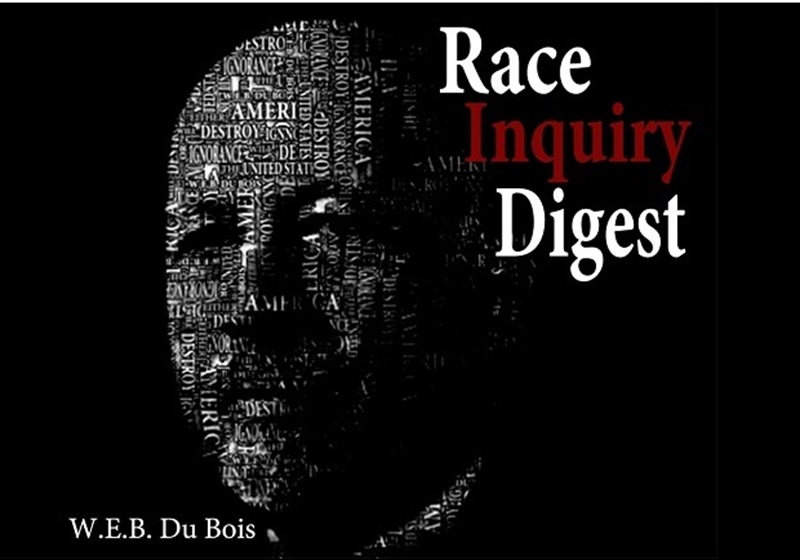 History of The Crisis Magazine: “A Record of the Darker Races.” By the NAACP
Editor’s Note: It is no accident that Race Inquiry Digest was inspired by The Crisis. Illustration by Marcia Dixon
The Crisis magazine is the official publication of the NAACP. It was created in 1910 by renowned historian, civil rights activist, sociologist and NAACP co-founder W. E. B. Du Bois.
Du Bois founded The Crisis in one room of the New York Evening Post building in New York City and edited the publication until 1934. A group of NAACP leaders, who included Du Bois, Mary White Ovington, and William English Walling, decided to adapt the name from James Russell Lowell’s poem The Present Crisis, written at the height of the Civil War.
In the November 1910 premier issue of The Crisis, Du Bois wrote that the goal of the publication was to “set forth those facts and arguments which show the danger of race prejudice, particularly as manifested today toward colored people.” DuBois noted that The Crisis would be a “a record of the darker races.” Read more
Political / Social
 Biden’s case for re-election is improving, but his polling against Trump is still shaky. By Sahil Kapur / NBC News
In 2020, surveys showed Biden consistently leading Trump nationally and in swing states, often by wide margins. But this time, the polls show Biden in a more precarious position.
The economy is improving, inflation is falling, joblessness is down, and the stock market is hitting record highs. Crime is dropping. U.S. crude oil production is at an all-time high. A special counsel declined to bring charges against President Joe Biden for mishandling classified information, and the Republican impeachment inquiry is flailing. Read more
Related: Obama jumps in to help Biden defeat Trump again. By and Zeleny / CNN
 “Hastening his deterioration”: Dr. John Gartner on impact of court trials on “Trump’s fragile brain.” By Chauncey Devega / Salon
“He is cognitively weak and closer than you might think to being completely disabled”
Continuing with our ongoing conversation about Trump’s apparent cognitive challenges, I spoke with Dr. Gartner several days ago via email about the failures of the American news media, the MAGA people and their devotion to their Dear Leader, and what will likely happen next if Trump’s behavior continues to trend in the same direction. Read more
Related: Trump Suggests He’s Like Jesus As Hearing Over Porn Star Payment Begins. By
Related: NY judge issues gag order on Trump in hush money trial. By , and
 Top NAACP Boss Warns of “Nazism Part Two” if Trump Is Elected. By Garrison Hayes and Arianna Coghill / Mother Jones
“It’s about whether or not we have democracy or we have fascism. Period. Full stop.”
The President of the nation’s leading Black civil rights organization has issued a stark warning to voters as the election shapes up to be a rematch between Joe Biden and Donald Trump—framing this year’s fight for the White House as a battle to beat back fascism itself. “We are looking at Nazism part two,” said NAACP President and CEO Derrick Johnson, in an exclusive interview with Mother Jones’ Garrison Hayes last Thursday. “We need to be very careful.” Read more
 Less than 40 percent of young Black voters say they will vote this year: Poll. By Cheyanne M. Daniels / The Hill
The poll, conducted by In Our Own Voice: National Black Women’s Reproductive Justice Agenda with Perry Undem and released on Monday, found that just 38 percent of Black voters between the ages of 18 and 29 said they are “almost certain” to vote in the fall. This number is in stark contrast to 59 percent of all respondents who said the same.
A gender divide also cropped up in the poll. While 63 percent of Black men said they are “almost certain” to vote in November, 56 percent of Black women said the same. While 54 percent of total respondents said voting in the 2024 elections is “extremely important, 48 percent of young Black voters lean away from thinking it’s important to vote this fall. Read more
 Black People Made Up 61% Of Exonerees In 2023, New Report Finds. By Shannon Dawson / Newsone
Out of 153 exonerations in 2023, around 61% of exonerees were Black, according to a new report published by The National Registry of Exonerations released on March 18. New York, Illinois, Pennsylvania, California, and Oregon were the top states for exonerations last year.
In 2023, individuals who were cleared of wrongdoing collectively reclaimed 2,230 years of their lives that had been unjustly taken away. On average, each exoneree endured 14.6 years of wrongful imprisonment, according to the new study. Read more
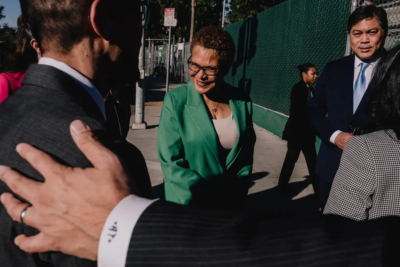 The Mayor of Los Angeles Wants to Prove Homelessness Can Be Solved. By Jill Cowan / NYT
In her first year as Los Angeles mayor, Karen Bass focused on moving homeless people off the streets and into motels through her Inside Safe program.Credit…Mark Abramson for The New York Times
When Karen Bass took office as Los Angeles mayor with a mandate to tackle homelessness, Venice Beach was at the top of her agenda. By late 2022, more than 100 people were living there in wall-to-wall tents alongside seven-figure bungalows, a shop selling $180 linen pillowcases and the Gold’s Gym that Arnold Schwarzenegger made famous. On a recent morning in the neighborhood, however, dog walkers navigated the wide sidewalks with little trouble, and there wasn’t a tent in sight. Read more
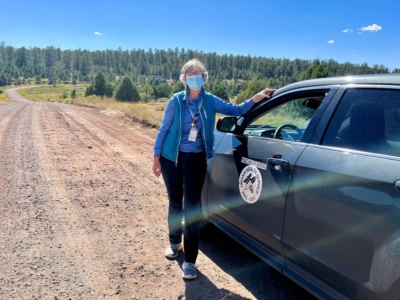 Rapid rise in congenital syphilis hits Native American communities hardest. By Cecilia Nowell / NPR
From her base in Gallup, New Mexico, Melissa Wyaco supervises about two dozen public health nurses who crisscross the sprawling Navajo Nation searching for patients who have tested positive for or been exposed to a disease once nearly eradicated in the U.S.: syphilis.
Infection rates in this region of the Southwest — the 27,000-square-mile reservation encompasses parts of Arizona, New Mexico, and Utah — are among the nation’s highest. And they’re far worse than anything Wyaco, who is from Zuni Pueblo (about 40 miles south of Gallup) and is the nurse consultant for the Navajo Area Indian Health Service, has seen in her 30-year nursing career. Read more
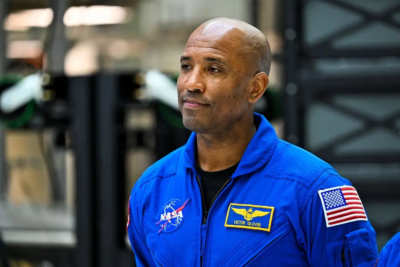 NASA Is Recruiting a New Class of Astronauts. Kenneth Chang and
Victor Glover, the pilot of NASA’s Artemis II mission to the moon next year, discussed his experience of applying to be an astronaut during a recent interview.Credit…Chandan Khanna/Agence France-Presse — Getty Images
Ms. Jordan is on a media tour to spread the word that “the right stuff” for being an astronaut in 2024 is not the same as what it was in the 1960s, when astronauts were all white men, almost all from the military. Joining her on that tour, which included a stop at The New York Times, was Victor Glover, a nine-year veteran of the astronaut corps who offered a glimpse into how he made it through the rigorous selection process. Read more
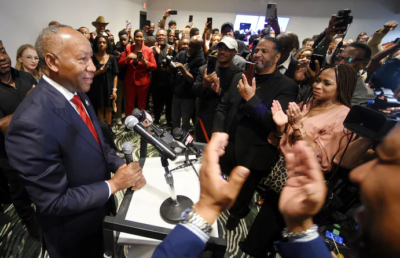 How to elect a Louisiana sheriff: Runoff, recount, reversal, repeat. By Molly Hennessy-Fiske / Wash Post
Henry Whitehorn, a candidate for sheriff in Caddo Parish, La., speaks to supporters after election results are announced on Saturday evening. (Henrietta Wildsmith/Shreveport Times/AP)
In this parish where family roots and political loyalties hold strong, just like the live oaks along the banks of the Red River, many people can’t remember the last time they had a competitive sheriff’s race. So when Sheriff Steve Prator announced last summer that he would step down after more than four decades in law enforcement, residents braced for a divisive campaign. Yet few could have predicted that they’d have to go to the polls three times in six months to pick a successor — elections fraught with racial tensions and legal wrangling over voting rights that mirror national struggles. Read more
World News
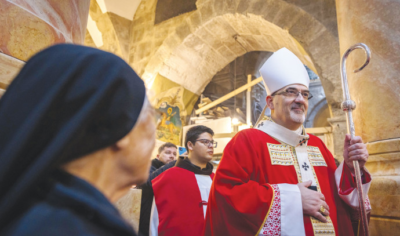 More than 140 global Christian leaders call for Gaza cease-fire in Holy Week letter. By
More than 140 global Christian leaders, including a Guatemalan Catholic cardinal and the presiding bishops of the Episcopal Church and the Evangelical Lutheran Church in America, called for a permanent cease-fire in Gaza and for an end to foreign military support for Israel in a Tuesday (March 26) letter to U.S. President Joe Biden and other politicians.
“We, as global Christian leaders, stand with our brothers and sisters in Christ in Palestine and around the world and say the killing must stop, and the violence must be brought to an end,” they wrote. “The horrific actions Hamas committed on October 7th in no way justify the massive deaths of tens of thousands of civilians in Gaza at the hands of the Israeli military.” Read more
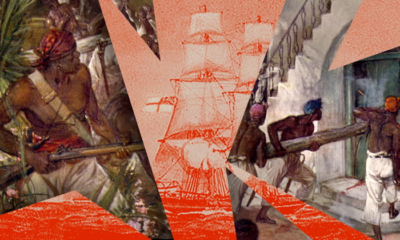 It’s not unpatriotic to tell the whole truth about Britain and the end of slavery. By Ella Sinclair / The Guardian
Composite showing a slave revolt in Jamaica in 1832; and HMS Black Joke, a former slave ship captured by the Royal Navy, serving with the West Africa Squadron in 1827. Composite: Guardian/National Maritime Museum/Chronicle/Alamy
Until very recently, most people in Britain would have said that this country’s most significant involvement in the transatlantic slave trade was our heroic decision to abolish it. In the past few years, this culturally ingrained consensus has been challenged by a renewed attention to Britain’s long-lasting legacy of slavery – and to the many families and institutions that profited from the enslavement of Africans. In the ongoing struggle to determine the meaning of this history, individuals and institutions across Britain’s political spectrum are grappling with the same pivotal question: how do we remember our past? Read more
 Insooni Breaks Racial Barrier to Become Beloved Singer in South Korea.
Born to a South Korean mother and a Black American soldier, she rose to a pioneering stardom in a country that has long discriminated against biracial children.
When she took the stage to perform at Carnegie Hall in front of 107 Korean War veterans, the singer Kim Insoon was thinking of her father, an American soldier stationed in South Korea during the postwar decades whom she had never met or even seen. “You are my fathers,” she told the soldiers in the audience before singing “Father,” one of her Korean-language hits. “To me, the United States has always been my father’s country,” Ms. Kim said in a recent interview, recalling that 2010 performance. “It was also the first place where I wanted to show how successful I had become — without him and in spite of him.” Read more
Ethics / Morality / Religion
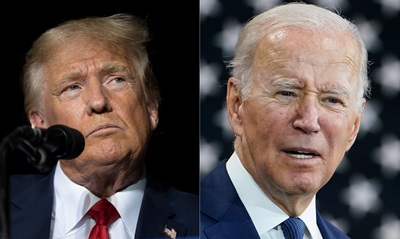 Are Trump, Biden religious? Americans don’t think so. That’s a problem. By Chris Brennan / USA Today
Trump campaigns as a divider, with-me-or-against-me bombast blaring at every rally. Maybe that has appeal now to people who see themselves as religious, and feel aggrieved about it.
Joe Biden, America’s second Catholic president, is often the subject of media coverage when he regularly attends church. Donald Trump’s best known trip to church came in June 2020, during his one term as president, when he walked from the White House to a nearby Episcopal church – after police forcibly cleared protestors angry about racial injustice – so he could hold up a bible for a photo op. Does religion factor into who people vote for president? Does it matter that Biden is a church-goer and Trump is a Bible waver? A Pew Research Center survey released last week found that 94% of Americans say it is very important or somewhat important for a president to live a moral and ethical life. Read more
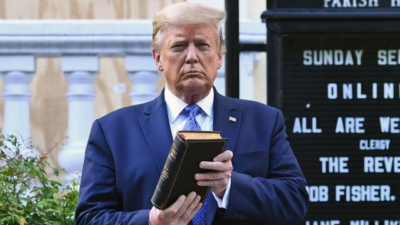 Trump Is Now Hawking ‘God Bless The USA’ Bibles. By
Donald Trump is preying — er, praying — his followers will pick up a Bible he’s hawking. On Tuesday, the former president posted a video on his Truth Social platform that was basically a three-minute commercial for the God Bless the USA Bible. For those not in the know, the GBTUB is a version of the holy book that combines the text of the King James Bible with some wholly unexpected additions. Read more
Related: An all-American Bible — with a cut of the sales going to Trump. By Phillip Bump / Wash Post
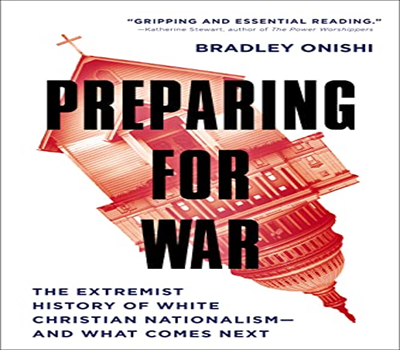 Preparing for War: The Extremist History of White Christian Nationalism—and What Comes Next. By David Rosen / NY Journal of Books
“White evangelicalism is a movement thoroughly entrenched in American nationalism, white supremacy, patriarchy, and xenophobia.”
If you were alarmed by the January 6th attack on the U.S. Capitol and the wave of racially motivated mass murders that have taken place over the last few years, you should read Bradly Onishi’s Preparing for War. This is a well written if scary book, a warning about the growing threat from what Onishi, a professor at the University of San Francisco, identifies as white Christian nationalism, aka the New Religious Right. Read more
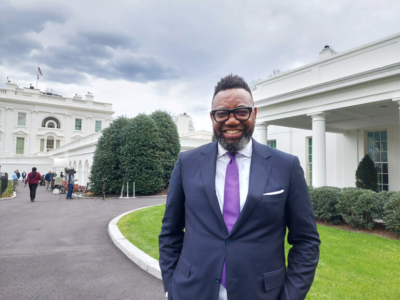 Religious affairs expert Thomas Bowen moves from city of Washington to White House. By Adelle M. Banks / RNS
In 2002, he joined the staff at Shiloh Baptist Church, a historic Black congregation, where he is minister of social justice. There he became known as a voice for the faith community in the district, and in 2016, Bowser made it official by naming him director of religious affairs.
At both the local and national level, Bowen’s portfolio has gone beyond the realm of faith. He also was the director of African American affairs for the District of Columbia and led its Office on Fathers, Men and Boys. At the White House, his responsibilities in the Office of Public Engagement also include outreach to “the diaspora of white, ethnic countries in Europe, such as Ireland, Italy, Greece.” Read more
Historical / Cultural
 Free Blacks in Accomack County during the Antebellum Period.
By Sabrina Watson / AAIHS
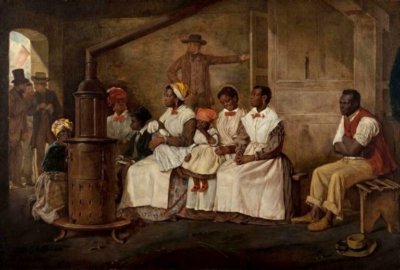
“Slaves Waiting for Sale,” 1861 (Eyre Crowe, Wikimedia Commons)
During the Antebellum period, freed African Americans in Virginia were often summoned to appear in the County Court for violating the General Assembly’s 1806 Act ordering manumitted Black people to leave the state within twelve months or face re-enslavement. However, in Accomack County, many freedmen refused to appear before the court and remained in Virginia, despite the risk of capture, prosecution, and the loss of their freedom once again. One such freedman was Joe Watson. Read more
Related: Is sorry enough? What Black Americans are owed in reparations. By Rachel Hatzipanagos / Wash Post
 Northern Journalism in the Promotion of the Lost Cause. By Marvin Walker / AAIHS
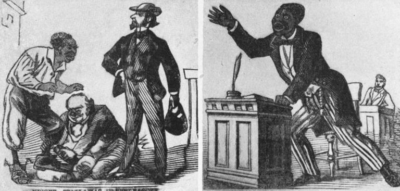
Scenes in the First Reconstructed Legislature (Schomburg Center for Research in Black Culture, Jean Blackwell Hutson Research and Reference Division)
During the Reconstruction and Jim Crow Eras, the American public was bombarded with media that dehumanized African Americans to maintain white supremacy and build a bridge of peace between Northerners and Southerners. Thus, the historical and political legacy of the Lost Cause Myth was the reunification of the North and South. As historian Alan T. Nolan explained, “the virulent racism that the North shared with the South, in spite of Northern anti-slavery views, was a premise of the Lost Cause and the principal engine of the North’s acceptance of it.” Read more
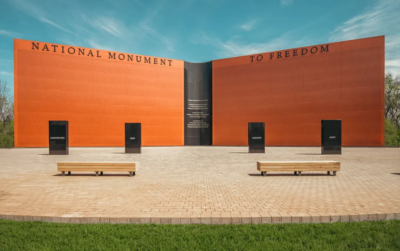 Bryan Stevenson Says a Quest for “Historical Authenticity” Inspired the Freedom Monument Sculpture Park. By Kia D. Goosby
A powerful new landscape of art in Montgomery, Alabama, aims to re-center American history on the enslaved and Indigenous people who lived through its brutality.
For the past two years, Stevenson has been pouring himself into another artistic extension of his advocacy, the newly opened Freedom Monument Sculpture Park. The park, seated on 17 acres along the Alabama River, has a deep-rooted historical significance as a place where enslaved African people were once trafficked. The park is the third of EJI’s Legacy Sites, which also include the Legacy Museum and the National Memorial for Peace and Justice, all in the city known as the birthplace of the Civil Rights Movement. Read more
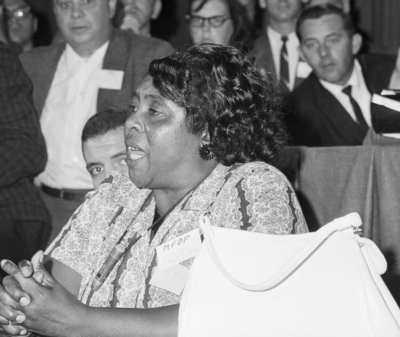 Why civil rights icon Fannie Lou Hamer was ‘sick and tired of being sick and tired.’ By Marlee Bunch / The Conversation
Fanny Lou Hamer speaks out against Mississippi’s racist voting laws on Aug. 8, 1964. Bettmann/Getty Images
While in jail, Hamer told the Harlem rally, “I began to hear the sounds of licks and I began to hear screams. I couldn’t see the people, but I could hear them. … They would call her awful names. And I would hear when she would hit the floor again.” After a while, Hamer said, she saw a friend pass her cell. “Her clothes had been ripped off from the shoulder down to the waist,” Hamer said. “Her hair was standing up on her head. Her mouth was swollen and bleeding. And one of her eyes looked like blood. … And then three men came to my cell.” Hamer was beaten, too, and sustained injuries that left her with lifelong injuries to her eyes, kidneys and legs. The experience also left her with little choice but to fight back. And fight she did, until her death at the age of 59 on March 14, 1977. Read more
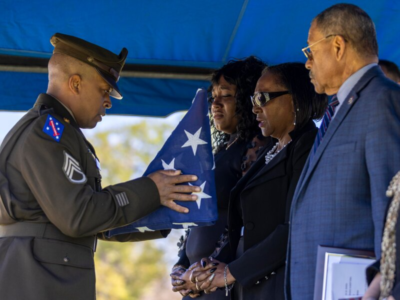 83 Years After His Killing, a Black Soldier Gets an Army Funeral. By Alexa Mills / NYT
Pvt. Albert King, shot dead by a white military police officer in Georgia in 1941, was blamed for his own death and buried in an unmarked grave.
In a Georgia cemetery, surrounded by tombstones cracked and worn by decades of rain and sun, Pvt. Albert King’s gleams new and bright. The Army unveiled it Sunday in a full military funeral, 83 years late. Since 1941 his body has rested in an unmarked grave near the military base where a white military police officer shot and killed him. Though Private King enlisted to fight in World War II, it was a fight with white bus drivers and soldiers on a segregated bus that cost him his life. After he escaped the bus and ran, the police officer found him, killed him and was exonerated in a sham military trial the same day. Read more
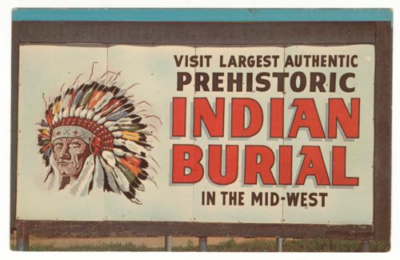 Once a Roadside Attraction, a Native Burial Site Nears Repatriation. By Julia Jacobs / NYT
Centuries-old grave mounds in Illinois became a flashpoint in the debate over displaying Native American remains. Now, tribes are close to seeing them reburied.
In 1927, on a bluff overlooking the Illinois River Valley, a chiropractor named Don Dickson took a shovel to his family’s farmland in Fulton County, Ill., and uncovered burial mounds dating back eight centuries.He scooped out the dirt, exposing the open graves of more than 280 Native Americans, many of whom had been buried among their possessions, and began charging admission, making it a roadside tourist stop. In the decades that followed, the Illinois State Museum turned the site into a full-fledged museum, excavating more than 800 skeletal remains before constructing the building that stands there today. Read more
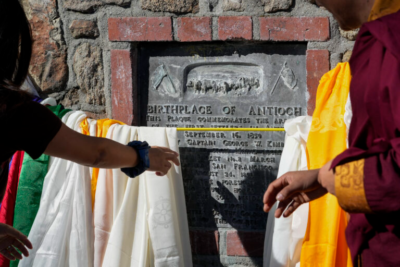 A California city wrestles with its history of discrimination against early Chinese immigrants. By
Chinese laborers were among the early population in Antioch, which was named in 1851. They likely numbered just under 100, said Lucy Meinhardt, an Antioch Historical Society Museum board member. They worked in farms, canneries and mines. They helped build river levees and established a Chinatown where the city’s downtown now stands. In the 19th century, Chinese people across California endured discrimination such as wage disparity, bans on property ownership and sundown laws that barred them from going outside after dark. Those working and living around Antioch were no different. Read more
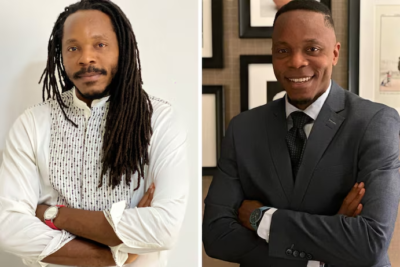 I didn’t know what my dreadlocks meant until I cut them off. By David Moinina Sengeh / Wash Post
Sports
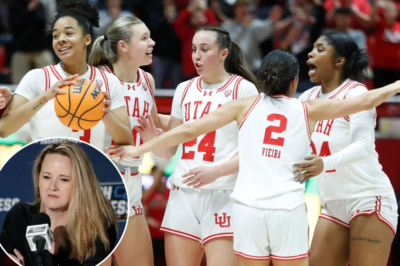 What happened to Utah women’s basketball team was horrible and also typically American. By Mike Freeman / USA Today
It is of course true that what happened to the Utah women’s basketball team was horrible. Members of the team told KSL.com they were subjected to racial slurs on multiple occasions while entering and later departing a restaurant in Coeur d’Alene, Idaho. It is also true that whoever decided to put the team in a hotel in that town lacked the historical understanding, or simply didn’t care, about the ugly white supremacist history of Idaho and that town in particular. Read more
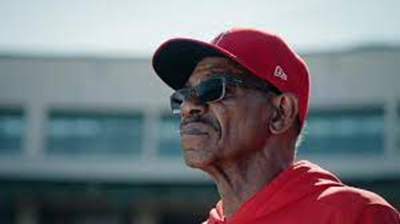 Ron Washington is at the center of Black baseball. By Andscape
New Los Angeles Angels manager Ron Washington’s six decades in professional baseball as a player, coach and manager have yielded a true statistical and roster readout of Black players that borders on the fantastical. And with longtime manager Dusty Baker now retired, Washington is at the center of the Black baseball version of ” six degrees of separation.” Read more
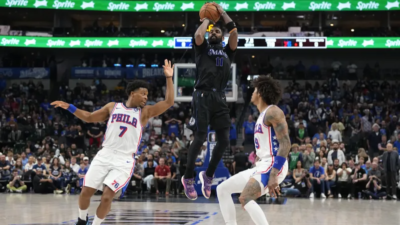 Kyrie Irving found his tribe at Anta Sports and got the shoe deal he always wanted. By Maurice Garland / Andscape
The story behind how the Anta design team and the Dallas Mavericks star combined forces for the KAI 1 sneakers
It was just before noon on March 6, a day warm enough for a hoodie and shorts in Dallas’ artsy Deep Ellum district. Even though the sneaker launch didn’t officially start until 6 p.m., there was already a line at the entrance of Sneaker Politics in anticipation of Dallas Mavericks point guard Kyrie Irving’s first shoe with China-based brand Anta Sports, the KAI 1. With its lawn chairs and carryout food containers, this scene recalled a time when camping out was popular in the sneaker community. Read more
Site information
Articles appearing in the Digest are archived on our home page. And at the top of this page register your email to receive notification of new editions of Race Inquiry Digest.
Click here for earlier Digests. The site is searchable by name or topic. See “search” at the top of this page.
About Race Inquiry and Race Inquiry Digest. The Digest is published on Mondays and Thursdays.
Use the customized buttons below to share the Digest in an email, or post to your Facebook, Linkedin or Twitter accounts.