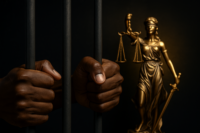
 Lady Justice is the universal symbol of the legal and judicial ideals a fair society strives to uphold. Her blindfold represents impartiality, the scales signify the balanced weighing of evidence, and the sword reflects the law’s authority to enforce its judgments. Together, these elements embody the expectation that justice should be fair, objective, and applied equally to all—without fear or favor.
Among the world’s advanced democracies, no nation incarcerates its people at the scale of the United States. America imprisons nearly 2 million human beings—five to ten times the rate of Canada, the United Kingdom, France, Germany, or Japan. No other modern democracy has normalized such punitive sentencing or such routine use of long-term confinement.
In a society that locks up more of its population than any other major democracy, the pardon should function as a vital corrective—an instrument of mercy to remedy wrongful convictions, extreme sentences, and the human wreckage of mass incarceration. Instead, the pardon has increasingly been twisted into a political favor, most brazenly under Donald Trump.
The racial contours make this even clearer. Black Americans are incarcerated at roughly five times the rate of whites, and Latinos nearly twice the rate. In some states, Black men make up more than half of the prison population while representing a small share of the broader population. These disparities reflect long-standing inequalities in policing, prosecution, and sentencing—not differences in crime.
Against this backdrop, Trump used the pardon power not to correct injustice but to reward loyalty. He granted clemency to January 6 offenders who attacked the peaceful transfer of power. He forgave financial fraudsters, political operatives, and well-connected criminals—men who were never vulnerable to the harsh machinery of American punishment. He selectively intervened in drug cases only when the offender had personal access to his circle, leaving tens of thousands serving the same mandatory minimums without hope.
Meanwhile, those who most need clemency—people serving decades for nonviolent offenses, those trapped under outdated drug laws, the wrongly convicted, and those placed on death row by flawed trials—remain unseen. The inhumanity of extreme or wrongful incarceration is staggering, and it feeds a deeper crisis: the perception that justice is no longer blind.
And when the rule of law loses legitimacy, society begins to unravel. People stop believing in courts, lose faith in institutions, and cease respecting laws that seem designed only for the unprotected. In that vacuum, cynicism grows, norms collapse, and lawlessness spreads—not because Americans have changed, but because the system has signaled that fairness itself is an illusion. If Trump’s vision of justice prevails, this is the America that awaits us: a nation where clemency is a currency for the connected, where accountability is selective, and where the very belief that America is exceptional among the nations of the world evaporates. A country that abandons fairness cannot long sustain freedom, unity or trust.