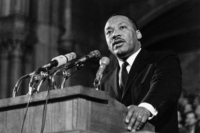
 What King’s 1967 condemnation of the Vietnam War reveals about the moral dangers of modern American warfare.
On April 4, 1967, in the sanctuary of Riverside Church in New York City, Martin Luther King Jr. delivered one of the most consequential speeches of his life. The address—Beyond Vietnam: A Time to Break Silence—was a sweeping moral indictment of the Vietnam War and of the American policies that sustained it. Breaking with many political allies and even some leaders within the civil rights movement, King warned that a nation claiming to defend freedom abroad could not wage war in ways that undermined justice, democracy, and human dignity.
King argued that the war was devastating domestic social programs, draining resources from the poor, and disproportionately sending Black and underprivileged young men to fight for freedoms they themselves lacked at home. In one of the most controversial passages of the address, he declared that the United States government had become “the greatest purveyor of violence in the world today.”
The charge shocked many Americans, but King insisted that the struggle for civil rights and the struggle for peace were inseparable. A nation that professed liberty and justice, he argued, could not simultaneously wage war in ways that contradicted those very principles. “We are called,” he said, “to speak for the weak, for the voiceless, for the victims of our nation and for those it calls enemy.”
The backlash was swift and severe. Major newspapers, political leaders, and even some of King’s allies in the civil rights movement criticized him for venturing beyond the boundaries of civil rights into the realm of foreign policy. Yet King understood that the moral crisis of war could not be separated from the moral health of the nation itself.
Today, as the United States again finds itself engaged in military conflict in Iran, King’s analysis of the Vietnam War invites uncomfortable parallels. In 1964 the Gulf of Tonkin Incident was presented as proof that the United States had been attacked by North Vietnam, a claim later shown to be misleading and used to justify massive escalation of the war. Today, critics argue that shifting explanations and disputed intelligence claims about threats from Iran echo earlier patterns in which the justification for war proved far less certain than originally presented.
The Moral Question of War
As a Baptist minister, King framed the Vietnam War not merely as a strategic mistake but as a profound moral crisis. In one of the most powerful passages of his Riverside speech he declared: “A true revolution of values will soon look uneasily on the glaring contrast of poverty and wealth… and say of war: ‘This way of settling differences is not just.’ This business of burning human beings with napalm, of filling our nation’s homes with orphans and widows, cannot be reconciled with wisdom, justice, and love.”
For King, the deeper danger was not only the destruction caused by war but the moral transformation it produced within the society that waged it. “A nation that continues year after year to spend more money on military defense than on programs of social uplift,” he warned, “is approaching spiritual death.”
The loss of moral bearings by a nation is not merely a political problem; it is also a spiritual one. The Bible offers a stark warning in the story of Sodom and Gomorrah, where moral decay became so profound that divine judgment followed. The lesson is less about ancient cities than about the enduring principle that societies which normalize cruelty and injustice eventually face the consequences of their own moral collapse.
One of the saddest chapters in recent warfare has been the bombing of a girls’ school in Iran that reportedly killed more than 150 school-age girls. Many observers have pointed to the United States as responsible. When asked about the tragedy, Donald Trump deflected responsibility and suggested that Iranian authorities themselves might have been responsible for the deaths of their own children. Such responses illustrate how easily the moral line separating legitimate defense from unjust violence can become blurred when civilian deaths—especially the deaths of children—are dismissed or explained away.
The moral clarity that once led the United States to oppose Nazi Germany during World War II now appears increasingly distant. In its place are practices—assassinations, civilian killings, and the destruction of infrastructure unrelated to the immediate conduct of war—that erode the ethical foundations on which American leadership once rested.
In a previous essay on this site, Is America Becoming a Terrorist State?, I raised a troubling question. The trajectory of recent events makes that question increasingly difficult to dismiss. An administration that appears accountable to no meaningful authority risks destabilizing not only international order but the moral credibility of the nation itself. When Trump was asked about the morality of American actions, he replied that he was bound only by his own morality.
Nearly six decades ago, King warned that a nation which abandons justice and humanity in the conduct of war ultimately endangers its own soul. Nations, like individuals, cannot indefinitely escape the consequences of moral failure. The question now is whether Americans will insist that power remain subject to law, conscience, and democratic accountability before the nation travels too far down a darker and more dangerous path. The real test of King’s moral witness is whether Americans are willing to hear it now, when war is once again being waged in their name.
If this essay mattered to you, future work from On Race in America is delivered directly by email.