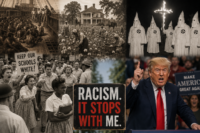
 The Trump administration and its allies in the Republican Party have launched a broad attack on many of the policies and institutions that emerged from the civil rights era.
Diversity, equity, and inclusion initiatives have been targeted across government and the private sector. Colleges and universities have been pressured to abandon diversity efforts, while Black studies programs and discussions of race have increasingly come under political attack. The conservative majority on the Supreme Court has ruled against affirmative action and weakened voting rights protections, particularly involving Black voting districts. Several red states have restricted how Black history and race may be discussed in schools, while also curtailing discussions of Critical Race Theory.
Black Americans have also been disproportionately affected by rollbacks within parts of the federal workforce and higher military ranks. Black unemployment continues to exceed that of white Americans and remains among the highest of any racial or ethnic group. Housing discrimination, health care disparities, and weak enforcement of civil rights laws remain persistent realities.
For those who believed racism was largely a relic of the past, these developments are difficult to ignore. They suggest that racism remains an active and evolving force in American life.
While prejudice has affected many groups in America, the central historical axis of American racism has been the relationship between Black and white Americans, rooted in slavery, segregation, and the long struggle over citizenship and equality.
At the outset, it is important to distinguish between racial feelings and racism. Racial feelings are the fears, stereotypes, prejudices, and resentments individuals may experience regarding race. Racism, by contrast, is the broader social phenomenon that institutionalizes those feelings through systems of power, law, custom, and social practice. Historically, the two became mutually reinforcing.
From the beginning of the transatlantic slave trade, negative racial attitudes toward Africans were transformed into a political and economic system designed to justify enslavement. Slavery required more than labor exploitation; it required an ideology portraying Africans as naturally inferior and therefore deserving of bondage.
America’s racial history elevated this tendency into a defining social order. Slavery and segregation did not simply oppress Black Americans; they also shaped the psychology of the dominant society. Racism narrowed empathy, normalized double standards, and trained generations of Americans to accept unequal humanity. Those racial assumptions became embedded within institutions governing housing, education, policing, voting, and economic opportunity, reproducing inequality across generations.
It is within this context that Critical Race Theory emerged. At its core, the theory argues that racism is not merely personal prejudice, but is also embedded within institutions and social structures. The intense reaction against it reflects how unsettling this insight remains for many Americans.
America has undeniably made substantial progress in reducing overt racial discrimination. Legal segregation was dismantled. Voting rights protections were established. Opportunities once denied to African Americans expanded dramatically across education, government, business, entertainment, and the military. Interracial interaction and acceptance have increased across much of American society.
Yet these gains have also fueled a resurgence of white grievance politics, white supremacy, and a broader unraveling of race relations in parts of the country. While the Civil Rights Movement dismantled many formal structures of racial exclusion, racial feelings proved far more difficult to eliminate and nearly impossible to legislate away. In some sectors of American life, there has been a backlash against affirmative action, diversity initiatives, integration policies, and even honest discussions of race itself.
Religion sits directly at the intersection of racial feelings and institutional racism. Christianity teaches that all people are created in the image of God and commands believers to “love thy neighbor.” Yet many churches historically accommodated slavery, defended segregation, and tolerated racial exclusion. The rise of Christian nationalism within parts of the Republican and MAGA base reflects a growing rupture between traditional Christianity, grounded in compassion and universal human dignity, and a more politicized Americanized version of the faith shaped by nationalism and cultural grievance.
Over time, racial feelings and institutional racism became inseparable. Prejudice created discriminatory institutions, while those institutions normalized and reproduced prejudice across generations. Racism thus evolved into a broader social ideology sustained by both feeling and structure.
Racism now, in this broader formulation, which includes both racial feelings and institutionalized structures of oppression, is often discussed only in terms of the damage it inflicts on its victims. But racism has also infected those who practice it, defend it, and benefit from it. Like a virus, it has spread through the bloodstream of the nation, weakening moral judgment, narrowing empathy, distorting Christianity, and making America less faithful to its democratic ideals.
Although rooted primarily in the historical relationship between Black and white Americans, the moral consequences of racism extend far beyond race relations alone. A society accustomed to assigning lesser value to Black lives risks normalizing selective compassion in other areas as well — toward immigrants, the poor, political outsiders, and even foreign populations affected by war and violence.
Any discussion of racism at the present moment must confront the political reality that the Trump administration and its Republican allies intend to uproot many of the racial protections and policies established since the civil rights era. The response must be vigorous, democratic, and political, culminating at the ballot box. Nevertheless, political administrations may come and go, while the deeper problem persists. America still suffers from a conscience infected by negative racial feelings reinforced through institutions, culture, and politics. We cannot fully dismantle institutional racism until we confront the prejudices and resentments that sustain it.
What is needed is a broad national and civic campaign designed to root out prejudice in all of its forms. Australia’s “Racism. It Stops With Me” initiative, which has evolved into “There’s Nothing Casual About Racism,” offers one useful civic model, while Brazil’s stronger anti-racism laws demonstrate a more aggressive legal response to personal and structural discrimination.These laws operate to punish individual bigotry while mandating systemic societal shifts to correct historical inequalities. America needs its own version — involving schools, churches, workplaces, civic organizations, media institutions, and government itself.
Such a campaign would not merely seek tolerance. It would aim to restore the nation’s moral vision, strengthen democratic values, and reaffirm the equal worth of every human being. Perhaps the greatest beneficiaries would be America’s children, born and unborn, freed from inheriting the fears and moral contradictions of the past.
For too long America has underestimated the depth of the infection. Racism is not simply prejudice. It is a contagion that weakens democracy, corrodes empathy, distorts religion, and damages the soul of the nation.
The task before us is no less than this: End the contagion.