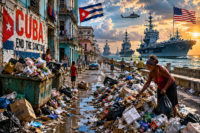
 Like the United States, Cuba was built on the labor of enslaved Africans. African slaves helped create the wealth of the island while receiving little of its benefits. Their descendants left an enduring mark on Cuban culture, religion, music, and daily life. The African presence in Cuba remains as visible today as it is throughout the Black diaspora.
The social conditions that produced the Cuban Revolution of 1959 were rooted in profound inequality. Under the dictatorship of Fulgencio Batista, Cuba became a playground for wealthy Americans, foreign corporations, and organized crime while many Cubans lived in poverty. Racism and colorism reinforced these divisions, with lighter-skinned Cubans generally enjoying greater access to economic and political opportunity than darker-skinned Cubans.
The revolution initially sought to address these injustices. Discrimination was outlawed, education expanded, health care became universal, and income inequality was reduced. Yet over time, the revolution lost much of its original promise. Political power became concentrated in the hands of a ruling elite, dissent was restricted, economic inefficiencies multiplied, and Cuba evolved into an authoritarian state. Acknowledging these failures, however, should not blind us to the suffering of ordinary Cubans today.
Across the island, rolling blackouts leave communities without electricity for most of the day. Food, medicine, fuel, and other essential supplies are increasingly scarce. Families struggle to preserve food, care for the sick, and endure the intense Caribbean heat without reliable power. For many Cubans, daily life has become a struggle to secure necessities that most Americans take for granted.
The current humanitarian crisis did not arise in a vacuum. Cuba’s economic system bears responsibility for many of its failures. Yet recent Trump administration policies has also contributed to the island’s suffering. The tightening of sanctions, restrictions on financial transactions, and limitations on economic engagement have further isolated Cuba from resources and markets. Defenders of these policies argue that they target the Cuban government. In practice, however, the burden falls overwhelmingly on ordinary Cubans. When policies contribute to shortages of food, medicine, fuel, and electricity, the distinction between punishing a government and punishing a people becomes increasingly difficult to justify and sustain.
For African Americans, the Cuban crisis cannot be viewed in isolation. The policies of the Trump Administration toward Cuba, immigration, and conflicts affecting predominantly non-white populations abroad reveal a troubling pattern. Whether directed at migrants seeking refuge, Palestinians trapped in war zones, or Cubans enduring economic deprivation, the burden of these policies falls disproportionately on people of color.
This is why Cuba matters. The question is not whether one supports the Cuban government. The question is whether ordinary Cubans should be subjected to conditions that contribute to hunger, medical shortages, prolonged blackouts, and economic hardship in pursuit of political objectives.
At some point, humanitarian concerns must take precedence over ideology. The measure of any policy should be whether it improves the lives of ordinary people and advances a society that is more democratic, equitable, and accountable. By that standard, the suffering now experienced by millions of Cubans should concern us all.
The more important question is: What can Americans do? The answer begins with citizenship itself. Policies are not inevitable; they are the product of political choices. If Americans believe that engagement is preferable to isolation, diplomacy preferable to coercion, and humanitarian concern preferable to collective punishment, then they must support leaders who share those values. Elections matter. The future of U.S.-Cuban relations, and the well-being of millions of Cubans, will be shaped not only in Havana but also at the ballot box in the United States.
We end where we began: African Americans should care about Cuba because the Cuban story is, in many respects, our story—a history of slavery, racial hierarchy, cultural resilience, political struggle, and, today, human suffering. The lesson of Cuba is the same lesson African Americans have learned throughout our own history: justice requires both memory and action. We remember the past, but we act in the present. Today, that means recognizing the humanity of the Cuban people and supporting policies that place human welfare above ideology, punishment, and political revenge. If our histories are intertwined, then so too are our obligations to one another.