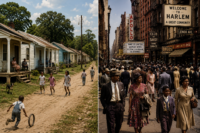
 Residential segregation is often portrayed as the result of personal choice. In reality, much of America’s racial housing pattern was created by public policy. Redlining, restrictive covenants, discriminatory lending, and exclusionary zoning confined many Black families to specific neighborhoods while creating opportunities elsewhere. Although these practices have largely disappeared from law, their effects remain embedded in American society. Their legacy can be seen in three critical areas of American life: education, wealth accumulation, and political representation.
One consequence is educational inequality. Historically, public schools were funded largely through local property taxes, linking educational resources to neighborhood wealth. Because residential segregation depressed property values in many Black communities, it also contributed to unequal educational opportunities. While many states and school districts have increased public funding to reduce these disparities, significant gaps remain in school resources, academic offerings, and educational outcomes. More recently, the diversion of public funds to charter schools and voucher programs has placed additional strain on many traditional public-school systems. What often appears to be an educational gap is, in part, a housing gap.
A second consequence is unequal wealth accumulation. For most families, a home is their largest financial asset and the primary means of transferring wealth across generations. My parents saved enough money in the 1950s to build a modern home with a swimming pool in Tampa, Florida. Yet segregation and housing discrimination effectively prevented them from building in neighborhoods comparable to those available to white families. As a result, the home was built in the Black community. Today, that same house is worth hundreds of thousands of dollars less than a comparable home in a historically white neighborhood. This difference is not simply a market outcome; it reflects decades of unequal investment and lost appreciation. In effect, residential segregation became a form of state-sanctioned equity theft.
A third consequence is political inequality. Residential segregation concentrated Black populations into identifiable geographic areas, making them vulnerable to vote dilution. Section 2 of the Voting Rights Act was designed to address precisely this problem by protecting minority voters from districting practices that weakened their political influence.
In recent decisions, however, the Supreme Court has increasingly emphasized evidence of racial progress while placing less weight on the continuing effects of residential segregation. The result has been to expose a persistent vulnerability: communities that were historically segregated remain susceptible to redistricting schemes that fragment or diminish their voting strength. In several states, legislatures have moved aggressively to redraw district lines in ways that reduce Black political representation. What began as residential segregation thus continues to shape political power, even decades after the formal barriers of Jim Crow were dismantled.
These three consequences—unequal schools, unequal wealth, and unequal political representation—share a common origin. Residential segregation did more than determine where people lived; it shaped access to opportunity, economic security, and political power.
The Supreme Court may see evidence of racial progress, but the enduring effects of residential segregation remain visible in the quality of schools, the accumulation of household wealth, and the distribution of political power. Geography, shaped by past public policy, continues to influence opportunity today.
This raises a simple question: Does government have a responsibility to address inequities that government helped create? If democracy is based on equal opportunity and fair representation, the answer must be yes. Otherwise, residential segregation remains not merely a relic of the past, but a continuing system through which inequality is reproduced from one generation to the next.