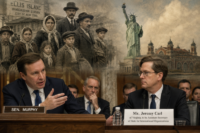
 There was a revealing moment in a recent Senate Foreign Relations Committee hearing. Senator Chris Murphy questioned Jeremy Carl, President Trump’s nominee for Assistant Secretary of State for International Organizations, about his past writings on “white identity” and the supposed “erasure of white culture.” Those writings prompted Murphy to ask a simple question: What is white identity? And what distinguishes it from other identities in America?
What followed was not a definition but a retreat. Carl moved from “Anglo-derived culture” to Scotch-Irish military traditions, then to Italian and Irish heritage. Pressed further, he cited church life, foodways, and even complained that the Super Bowl halftime show had not been in English. The exchange exposed a basic problem: when asked to define whiteness, its defenders fall back on European ethnic traditions. But those traditions are not whiteness. They are the identities that existed before those groups were absorbed into a racial category that conferred status, security, and power.
The difficulty Carl encountered points to a deeper truth. Whiteness in America is not a coherent culture. It is a political and social position that, over time, came to be treated as the default form of being American. As columnist Philip Bump observed in The Washington Post, claims that America was built on “white culture” capture a truth, though indirectly: for much of the nation’s history, whiteness and Americanness have been treated as interchangeable.
The confusion arises from the tendency to treat whiteness as if it were a culture. But culture is generally understood as a shared system of beliefs, values, practices, and forms of expression that develop within a community over time. By that standard, what is called “white culture” is less a unified tradition than a loose collection of European ethnic inheritances—Irish, Italian, German, Polish, Jewish, and others—each with its own history, religion, cuisine, music, and worldview. These traditions existed long before the groups that carried them were incorporated into the American category of white.
The distinction becomes clearer when contrasted with Black cultural formation in the United States. African American cultural forms—religious expression, music, language, and artistic traditions—emerged as collective responses to exclusion, domination, and survival under conditions of constraint. Their coherence and resilience reflect a shared historical experience. Whiteness, by contrast, did not emerge as a cultural response to marginalization. It developed as a social framework that organized advantage. Its function was not to sustain a community under pressure, but to consolidate status across otherwise distinct European groups.
For decades, scholars have examined this process in what is now known as whiteness studies—an interdisciplinary field spanning history, sociology, and cultural analysis. Their work shows how groups once considered outsiders—Irish, Italian, Jewish, and other European immigrants—gradually became “white,” gaining access to housing, jobs, political power, and social acceptance that were denied to others. The field’s central insight is that whiteness is not a biological reality or a unified culture, but a social category created and expanded through law, policy, and economic advantage.
Yet outside the academy, this history remains largely invisible. American museums have done vital work preserving the experiences of groups excluded from the national narrative. But the dominant identity that shaped the boundaries of inclusion and exclusion—the making of whiteness itself—has never been systematically interpreted for the public.
At first glance, the idea of establishing a “White American Museum” risks reinforcing the very problem it seeks to address. The name alone can sound like another monument to dominance rather than an invitation to understanding. That danger is real—and it must be addressed directly. Any such institution would have to make its purpose unmistakable: not to celebrate whiteness, but to historicize it; not to honor power, but to explain how it was constructed, expanded, and justified. Any attempt to glorify, celebrate, or excuse white supremacy would need to be explicitly prohibited in its charter.
The real need is for a museum about whiteness—its origins in colonial law, its expansion to include once-marginal European groups, its role in shaping access to land, education, and citizenship, and its lasting influence on how Americans understand merit, belonging, and national identity. Such an institution would bring the insights of whiteness studies into public view, showing how privilege became normalized and how inequality became embedded in everyday institutions.
Understanding this history is not about assigning guilt. It is about clarity. The United States cannot fully understand its debates over race, immigration, and identity without confronting the long-standing equation of whiteness with the American norm. The urgency of this work is reflected in the growing anxiety surrounding demographic change and the increasingly explicit politics of white identity. As the nation moves toward a future in which no single racial group will constitute a majority, that historical equation between whiteness and Americanness is now being unsettled.
The exchange in the Senate hearing revealed how fragile the idea of white identity becomes when it is forced into the open. A museum devoted to the history of whiteness would perform the same function for the nation: making visible what has long been treated as invisible. And only by seeing that history clearly can Americans begin to separate what it means to be white from what it means to be American.