 On June 6, during ceremonies commemorating the anniversary of D-Day in Normandy, Defense Secretary Pete Hegseth delivered remarks that drew attention not only for what they said about the past, but for what they suggested about the present.
Speaking at an event honoring those who fought and died to liberate Europe from fascism, Hegseth warned of the dangers posed by migration, demographic change, and what he described as “civilizational change.” Similar themes have appeared in statements by Secretary of State Marco Rubio, reflecting a broader narrative increasingly advanced by senior Trump administration officials: that migration from Africa, Asia, Latin America, and the Middle East represents not merely a policy challenge but a threat to the cultural and political character of the West.
International law draws an important distinction in these debates. While recognizing the sovereignty of nation-states, the postwar international order rejects the idea that governments possess a right to preserve a particular racial or ethnic composition. Nations may protect their borders, regulate immigration, encourage integration, and promote civic values. What they may not legitimately claim is a right to exclude people in order to preserve racial dominance or ethnic purity. That distinction is essential because arguments framed as cultural preservation can become vehicles for maintaining longstanding systems of privilege.
This raises a deeper question: Is the primary concern migration itself, or the demographic change that migration produces? As Western societies become more diverse, some political leaders have portrayed those demographic shifts as a civilizational crisis rather than a predictable consequence of immigration. The deeper concern is the demographic change that migration produces and the possibility that the racial composition of the United States and Europe will continue to evolve. Simply put, the underlying fear is that America and Europe will become less white.
These concerns have also been amplified by influential public figures, including Elon Musk, whose public statements and political engagement have helped move ideas about demographic replacement and civilizational decline from the political margins into mainstream discussion.
History offers a sobering warning. The twentieth century provides numerous examples of political movements built upon fears of demographic decline and racial replacement. The most notorious case emerged in Nazi Germany, where preserving an Aryan state became a central political objective, leading ultimately to persecution, genocide, and world war. Contemporary debates over immigration are not equivalent to the horrors of the 1930s and 1940s. Yet history reminds us that ideologies rooted in racial nationalism often begin with appeals to cultural preservation before evolving into far more destructive forms.
Reasonable people can disagree about border security, immigration levels, and the responsibilities of democratic nations. Those are legitimate questions of public policy. The greater danger arises when immigration is viewed primarily through the lens of preserving a particular civilization understood in racial or ethnic terms. At that point, the issue is no longer simply who enters a country, but who is considered to belong within it.
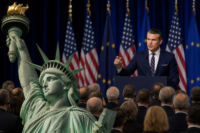
America has long offered a different ideal. The words inscribed on the Statue of Liberty—”Give me your tired, your poor, your huddled masses yearning to breathe free”—express a vision of nationhood grounded not in race or ancestry but in shared democratic principles. Whether that civic vision will continue to prevail over appeals to racial identity may become one of the defining questions of the twenty-first century.