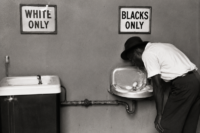
 Jim Crow was more than a system of segregation. It was a comprehensive social order maintained through law, intimidation, humiliation, economic exclusion, and, at its worst, racial terror. Although most closely associated with the South, its influence extended far beyond the former Confederate states. From the late nineteenth century until the mid-1960s, it shaped nearly every aspect of African American life.
I was born in 1945. My first twenty years were spent under Jim Crow in the South. My generation was the last to come of age while this system remained fully intact.
The most horrific aspects of Jim Crow—especially lynching and racial violence—have been thoroughly documented, nowhere more powerfully than the National Memorial for Peace and Justice in Montgomery, Alabama. Yet the daily experience of Jim Crow was also defined by countless acts of degradation that, taken together, reinforced the message that Black Americans were second-class citizens.
Growing up in Florida, segregation was enforced by both law and custom. Schools were segregated, but that was only the beginning. A trip downtown meant navigating separate drinking fountains, lunch counters, restrooms, movie theaters, waiting rooms, and entrances. Clothing and shoes could often be purchased, but Black customers were frequently prohibited from trying them on. Public parks, beaches, and swimming pools were reserved for whites. Residential neighborhoods and even cemeteries were divided by race.
Travel between cities brought its own humiliations. Because public restrooms were often reserved for whites, Black families frequently had no choice but to stop along lonely stretches of highway and retreat into the woods to relieve themselves. Even the most basic human needs became reminders of one’s assigned place in the racial order. Every public space reinforced the message that African Americans were expected to know—and never challenge—their place in society.
More than sixty years have passed since the legal foundations of Jim Crow were dismantled. America rightly celebrates the end of legalized segregation. But an important question remains: What were the lasting consequences of living under such a system, and have we honestly confronted them?
I have lived through both Jim Crow and its dismantling. Today, however, I also see signs of what might be called Jim Crow 2.0. Schools and neighborhoods are increasingly resegregated. Restaurants, department stores, and public accommodations are legally open to everyone, yet persistent economic inequality often produces patterns of separation that resemble those once enforced by law. Economic disparity now accomplishes what statutes and customs once required.
Perhaps the greatest failure has been our unwillingness to confront Jim Crow’s enduring psychological and social legacy. For generations, Black Americans were taught—both explicitly and implicitly—that they were inferior. That message justified exclusion, unequal opportunity, and unequal treatment. The damage cannot be measured simply by statistics. It shaped confidence, expectations, family wealth, educational opportunity, and relationships between Black and white Americans. Equally troubling is the widespread belief that because today’s Americans did not create Jim Crow, they bear no responsibility for understanding or addressing its consequences.
Our present-day polarization and recurring racial conflict are rooted in the long history of slavery, but they are even more directly traceable to the unfinished legacy of Jim Crow. Slavery ended in 1865. Jim Crow endured for another century, shaping the attitudes, institutions, and lived experiences of both its victims and its beneficiaries. It left deep psychological wounds among those who were excluded and enduring assumptions among those who benefited from a racially stratified society. Until Americans honestly reckon with those twin legacies, the divisions of the past will continue to shape the conflicts of the present.
Following the end of apartheid, South Africa established a Truth and Reconciliation Commission to publicly confront the injustices of the past and begin the difficult process of national healing. The commission did not erase history, but it acknowledged it.
The United States chose a different path. We dismantled the legal structure of segregation, but we never fully reckoned with what it had done to the nation or to the people who lived through it. Today, debates over history, race, and education often seek to minimize or erase that past rather than understand it.
Reconciliation begins with memory. A nation cannot heal from wounds it refuses to examine. It is never too late to tell the truth about Jim Crow—not to assign inherited guilt, but to understand the forces that shaped the America we inherited and the America we hope to become.