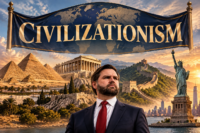
 Civilizationism is an idea and a movement that deserves our attention and understanding.
Leonard A. Schuette, a scholar at the Carnegie Endowment for International Peace, recently used the term to describe an emerging worldview within the American New Right. In Foreign Affairs and The New York Times, Schuette describes a conception of the West different from the familiar American ideal of a nation united principally by constitutional democracy, liberty, and equality.
In Schuette’s interpretation, civilizationism places greater emphasis on geography, Christianity, inherited culture, and ancestry. It is more than an appreciation of Western history. It is an argument about belonging and power: who constitutes the civilization, who may enter it, and who has the authority to protect its boundaries.
Vice President JD Vance provides a window into this thinking. Accepting the Claremont Institute’s Statesmanship Award in July 2025, Vance rejected the proposition that America is simply a set of abstract principles.
“America is not just an idea,” he said. “We’re a particular place with a particular people and a particular set of beliefs and way of life.”
Vance has not argued that immigrants cannot become Americans, and he has said that immigration can enrich the country. But ancestry enters his formulation. In his Claremont remarks, he suggested that Americans whose ancestors fought in the Civil War possess a particularly deep claim to the country.
That raises an unavoidable question: Whose ancestors?
Nearly 180,000 African American soldiers served in the Union Army during the Civil War, with thousands more serving in the Navy. African Americans had lived in North America for generations before independence. They cultivated its land, generated enormous wealth, fought in its wars, built institutions, and helped create American culture.
If historical rootedness strengthens one’s claim to America, African Americans possess one of the deepest claims of all.
History presents an even larger problem for civilizationism. Civilizations have never been racially pure or culturally sealed communities. They developed through migration, conquest, trade, borrowing, and cultural exchange. Western civilization itself emerged from centuries of interaction among Europe, Africa, the Mediterranean, and the Near East.
Civilization is not a bloodline.
Nor has America ever been one. Indigenous peoples, Europeans, Africans, and generations of immigrants created the society that became the United States. They did not enter equally or voluntarily, nor were they treated equally. But together they made America.
Civilizationism attempts to draw fixed boundaries around a history that repeatedly crossed them.
The argument also extends beyond America’s borders. Civilizationist thinking can envision the world as large spheres in which powerful states exercise predominant influence over surrounding nations: the United States in the Western Hemisphere, Russia within its claimed sphere, and China within its region.
Elements of this thinking can now be found in American foreign-policy discourse. The Trump administration has spoken of defending Western civilization and Western identity, while its 2025 National Security Strategy calls for restoring American preeminence in the Western Hemisphere through what it calls a “Trump Corollary” to the Monroe Doctrine.
Here the domestic and international dimensions converge.
At home, the question is who belongs.
Abroad, the question is who decides.
If ancestry, religion, or inherited culture becomes a measure of authentic national identity, citizenship alone may no longer settle the question of belonging. If powerful states acquire special authority over civilizational spheres, national sovereignty may no longer settle who determines a country’s future.
A world organized this way could give a handful of powerful states extraordinary influence over millions of people. Smaller nations could find their political futures constrained by the historical or civilizational claims of larger neighbors.
The people most affected would have the least power to decide.
That is the connection between civilizationism and democracy.
Liberal democracy rests upon two imperfect but consequential propositions. Within nations, citizenship should not depend upon ancestry, religion, or inherited status. Among nations, peoples should possess the right to determine their own political futures rather than having them determined by more powerful neighbors.
Neither America nor the international community has consistently honored those principles. But generations have struggled to extend citizenship, voting rights, equal protection, religious freedom, human rights, and national self-determination to people once denied them. The history of democracy, however uneven, has been a struggle to enlarge the circle of those entitled to freedom.
Civilizationism points in the opposite direction. At home, it risks narrowing who is regarded as fully American. Internationally, it risks subordinating smaller nations to the ambitions of great powers. In both cases, power moves toward those who claim the authority to define civilizations and defend their interests.
History has seen the consequences of organizing political power around ancestry, racial hierarchy, exclusion, and territorial domination. In the twentieth century, Nazism carried those ideas to their most horrific extreme. The result was dictatorship, world war, genocide, and the deaths of millions.
Civilizationism does not equal Nazism, and careless comparisons would obscure rather than illuminate the danger. But history leaves a warning. When governments acquire the power to determine which people truly belong, and powerful states claim the authority to determine the futures of weaker ones, both democracy and freedom diminish.
History has seen that world before.
Democracy was the struggle to move beyond it.