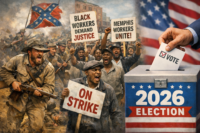
 For years, a persistent question has hovered over American politics: why do so many poor and working-class white Americans support Donald Trump when many of his policies work directly against their material interests? The answer is neither new nor mysterious. It was articulated with devastating clarity by W. E. B. Du Bois in his landmark 1935 work Black Reconstruction in America.
Du Bois argued that white workers were compensated not primarily through wages, but through status. He called it the “wages of whiteness”: non-monetary benefits such as social deference, legal advantage, and psychological elevation, conferred in exchange for upholding racial hierarchy and supporting an economic system that otherwise exploited them. These wages divided white laborers from Black laborers despite their shared exploitation. Race, not class, became the organizing principle of political loyalty.
As profound as Du Bois’s insight is, it did not originate in the twentieth century. It has been a governing strategy since the founding of the republic. The Civil War offers perhaps the clearest example of its operationalization. The Southern planter class—an elite minority—successfully convinced poor and landless white men, most of whom owned no slaves, to fight and die for the preservation of slavery. Between 260,000 and 300,000 Southerners perished in that war. They did not die defending their own economic interests; they died defending a racial order that granted them status while denying them power.
This same dynamic has repeatedly undermined efforts to build durable, multiracial working-class movements in the United States. During the 1930s and 1940s, the Communist Party made real but limited progress organizing Black workers and promoting interracial solidarity in certain industries and regions. Yet even during the depths of economic crisis, deep-seated white supremacy among large segments of the white working class proved difficult to overcome. The wages of whiteness remained a powerful barrier to class consciousness.
Seen through this historical lens, the appeal of Trumpism becomes clearer. The Trump administration has demonstrated a keen understanding of this playbook. Through the demonization of immigrants, the erosion of civil-rights protections, and the steady deployment of racial and cultural dog whistles, it offers symbolic compensation to those facing economic insecurity. Trump’s recent posting of a racist video of the Obamas is consistent with this strategy. These appeals are no less effective today than they were in the nineteenth century.
All of this unfolds amid staggering inequality. Wealth and income have become increasingly concentrated at the top, while wages stagnate and economic precarity spreads across the working and middle classes. Yet anger is consistently redirected away from concentrated wealth and toward racialized “others.” The result is political loyalty built not on material improvement, but on perceived status preservation.
There is a bitter irony in the administration’s obsession with destroying anything labeled “woke.” The term is weaponized to ridicule historical awareness and delegitimize structural critique, yet it is never meant to awaken poor and working-class whites to the reality of their own economic disadvantage. On the contrary, it functions precisely to keep them politically asleep—to ensure they do not recognize how thoroughly they are being exploited by the very elites they defend.
The next election represents more than a routine political contest. It is a reckoning with a centuries-old strategy that has repeatedly undermined democratic possibility in America. Either the wages of whiteness will finally be rejected in favor of a politics grounded in shared material interests and democratic renewal, or history will repeat itself. If the past is prologue, continued allegiance to racial hierarchy over economic justice will lead not to security or dignity, but to deeper inequality, economic decline, and the further unraveling of American democracy.
If this essay mattered to you, future work from On Race in America is delivered directly by email.