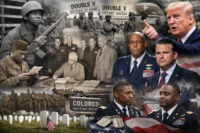
 In a time of war, a nation reveals not only its strength, but its character. For African Americans, that test has long carried a contradiction: to fight for democracy abroad while being denied it at home. From the Civil War to the present, Black Americans have answered the call to serve—even when the nation they defended failed to fully defend them. That contradiction is not merely historical. It shadows the present.
That willingness to serve, however, should never obscure the disrespect Black servicemembers endured within the ranks themselves. Before formal desegregation, Black men and women were routinely treated as second-class soldiers. They could be wounded, maimed, or killed for their country just as white soldiers could, yet they were often denied promotion, denied authority, and denied assignments that reflected dignity, trust, and leadership. One of the great moral tragedies in American life is to die defending a nation that still questions the full worth of your sacrifice.
The contradiction was perhaps most clearly expressed during World War II in what became known as the Double V campaign—“Victory Abroad and Victory at Home.” First advanced in 1942 by Black journalists and embraced by the Black press, the campaign called on African Americans to fight fascism overseas while simultaneously demanding an end to segregation and racial injustice in the United States. It was both a patriotic appeal and a moral indictment: a nation that claimed to defend freedom globally could not deny it domestically.
My father belonged to that Double V generation. During Jim Crow, he volunteered to serve in World War II, believing, as many did, that such service might help transform the nation he fought to defend. College-educated and ambitious, he sought to sit for the officers’ exam. He was denied—not for lack of ability, but because of his race.
He returned home to the same segregated society he had left. The promise of the Double V remained unfulfilled. Like many of his generation, he rarely spoke of his experience. His silence was its own kind of testimony.
A turning point came in 1948, when President Harry Truman ordered the desegregation of the armed forces. It did not end discrimination overnight, but it established a standard: a democratic nation could not defend itself with a segregated military.
Since then, the military has moved—imperfectly but meaningfully—toward a more integrated, merit-based force. That progress has strengthened not only fairness, but effectiveness. It is precisely for this reason that the Supreme Court, even as it curtailed affirmative action in higher education, acknowledged that the military occupies a distinct position—one where considerations of cohesion, leadership legitimacy, and national security may justify an attempt to increase diversity.
That is why recent developments are so troubling.
In 2025, President Donald Trump removed General Charles “CQ” Brown Jr., a highly decorated combat pilot with more than 3000 flight hours and extensive command experience, and only the second African American to serve as Chairman of the Joint Chiefs of Staff. In 2026, Defense Secretary Pete Hegseth reportedly blocked the promotion of four Army officers—including two Black officers—despite their having passed standard review. Such interventions are rare and break with long-standing norms. The hypocrisy here is stark, since Hegseth is considered the least qualified Defense Secretary in the history of the department.
These actions coincide with a broader campaign to eliminate so-called “DEI” efforts across the military. Framed as a return to merit, the effect is to cast suspicion on officers who have already earned their advancement. When diversity itself becomes suspect, merit is no longer neutral—it is redefined.
The consequence is deeper than personnel decisions. It risks eroding trust within the ranks, narrowing the leadership pipeline, and weakening the legitimacy that holds a fighting force together—the very concerns the Court itself implicitly recognized. By all measures, diversity is a strength not a weakness.
A democracy cannot afford to racialize its armed forces. It cannot ask citizens to defend freedom abroad while signaling, at home, that some are less fit to lead. Armies run on trust as much as power. When that trust fractures, cohesion falters—and with it, security.
The lesson of my father’s generation is not simply that they served. It is that they served with the expectation that the nation would honor their sacrifice by becoming more just.
If that expectation is broken, the question is no longer who will fight for the country—but what, exactly, they are being asked to fight for.
If this essay mattered to you, future work from On Race in America is delivered directly by email.