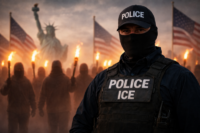
 The fatal shooting of a 37-year-old woman in Minneapolis by masked ICE agents has shocked the nation—but it should not have surprised it. What many view as an isolated tragedy is better understood as the foreseeable outcome of a governing approach that has normalized secrecy, intimidation, and force as instruments of authority. The masks worn by the agents were not incidental; they were emblematic.
That emblem has been articulated explicitly by Stephen Miller, the administration’s chief architect of immigration policy. As reported in The Atlantic’s profile “The Wrath of Stephen Miller,” Miller frames governance in terms of “force, power, and strength.” This formulation is not rhetorical excess; it is operational doctrine. It explains the embrace of masked enforcement at home just as it explains belligerence abroad. In this worldview, law is not a system constrained by transparency, restraint, and accountability. It is a weapon to be wielded decisively, anonymously, and without apology.
American history offers a sobering lesson about what the mask represents when power chooses concealment. In the mythology of the Old West, the masked outlaw signaled rejection of communal norms and responsibility. Early twentieth-century bank robbers used masks for the same reason: to commit acts of violence or theft without consequence. The Ku Klux Klan transformed the mask into a political instrument, institutionalizing anonymity as a mechanism of racial terror. The hood allowed ordinary citizens—often respected in public life—to terrorize Black communities while evading identification, shame, and punishment. The mask did not merely hide the face; it enabled the violence.
That lineage did not disappear with time. It resurfaced most visibly in Charlottesville, where masked white supremacists marched openly through American streets, insulated from consequence and emboldened by anonymity. What distinguishes the present moment is that this same logic has now been absorbed by the state itself.
Masked federal agents operating in American cities represent a profound inversion of democratic norms. When agents of the government conceal their identities, they deny the public its most basic safeguard: the ability to know who acts in its name and to hold them accountable for abuses of power. Anonymity, once the refuge of criminals and extremists, becomes a governing tool.
The consequences for democracy are severe. Self-government depends not merely on laws, but on visibility, restraint, and accountability. Masked authority thrives where fear replaces consent and secrecy replaces legitimacy. History is unambiguous: faceless power is never benign, and it never remains contained.
When the state puts on a mask, it does not protect democracy—it announces that it no longer answers to it.