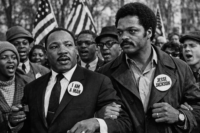
 While watching the funeral service for Rev. Jesse Jackson, I was reminded that every generation eventually confronts a moment when it must decide whether injustice will be tolerated—or whether the time has come to say that enough is enough.
It was not unusual for many of the young people who participated in the civil rights movement to suspend their careers, risk imprisonment, and demonstrate extraordinary courage in the face of unremitting violence. This generation reached a point where it collectively decided that enough was enough.
Yet the story does not begin with the generation of the 1960s. The stage had been set by the generation that preceded it—men and women whose lives were shaped by the fight for freedom abroad during World War II and who returned home determined to fight for freedom here. In a prior essay, “Splendid Isolation,” I described the contributions of this post–World War II generation. They created the conditions for resistance—both physical and psychological—among their children. The civil rights movement would not have been possible without the stability and determination forged by that earlier generation.
The ceremony honoring Rev. Jackson was therefore not only an act of remembrance. Again and again, the speakers returned to the urgency of the present moment, reminding the audience that the struggle for justice did not end with the victories of the past. The rights secured through sacrifice remain vulnerable, and the moral demands that animated the movement continue to confront the nation today.
The American civil rights movement followed the same historical pattern seen in other transformative movements. While the movement was blessed with extraordinary leadership—figures such as Martin Luther King Jr., Jesse Jackson, and many others—its strength ultimately rested on ordinary people. They were the students who sat at segregated lunch counters, the domestic workers who walked rather than ride segregated buses, the church members who filled mass meetings, and the families who risked intimidation, job loss, and violence simply for demanding their rights.
These ordinary men and women became the foot soldiers of the movement. Their willingness to march, boycott, vote, and endure arrest transformed moral protest into political power. Without their courage and persistence, even the most gifted leadership could not have succeeded. Rev. Jesse Jackson and his colleagues in the civil rights movement, including Martin Luther King Jr., belonged to the generation that helped organize and guide that awakened energy into a disciplined struggle for justice. Their efforts remind us that progress in this country has rarely come simply through goodwill or gradual adjustment. More often, it has come when citizens decide that the moral cost of injustice has become intolerable.
The question raised implicitly throughout the service was whether Americans today still recognize such moments. Every generation must decide whether it will accept the erosion of democratic norms and human dignity, or whether it will insist—peacefully but firmly—that the nation live up to its highest ideals.
As the country approaches the midterm elections of November 2026, many observers see the outcome as an inflection point that may determine whether democracy, as Americans have long understood it, can endure. If voters reject the current direction of Republican leadership and return Congress to Democratic control, the nation may yet avoid the most serious consequences of democratic erosion. If not, the country may find itself traveling further down a darker and more uncertain road.
History suggests that when institutions fail to resolve deep political conflicts, societies sometimes experience catalytic moments that awaken public consciousness and force a reckoning. The civil rights movement experienced such a reckoning in 1955 with the lynching of fourteen-year-old Emmett Till in Mississippi—and the decision by his mother, Mamie Till-Mobley, to hold an open-casket funeral, which forced the nation to confront the brutality of racial violence. Photographs of Till’s mutilated body shocked the conscience of millions and exposed the cruelty of the Jim Crow system.
Whether such a moment lies ahead for the United States remains uncertain. What is clear, however, is that history rarely waits patiently for nations unwilling to confront their own contradictions. The lesson of that earlier generation is clear: change occurs when ordinary people, stirred by such moments, refuse to accept injustice any longer.
The generation of the civil rights movement understood this truth. Their legacy is not only the rights they secured, but the example they set: that democracy survives only when citizens are prepared to defend it.
History suggests that every society eventually reaches a moment when its people must decide whether they will accept the erosion of their ideals—or whether they will stand and declare, with clarity and conviction, that enough is enough.
If this essay mattered to you, future work from On Race in America is delivered directly by email.