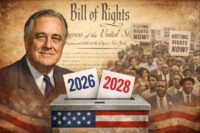
 America does not lack for rights. It lacks agreement on what those rights require in practice. That question—what citizens are owed not only in principle but in the conditions of their lives—has defined the nation at its most consequential moments.
The first Bill of Rights (the first ten amendments to the Constitution) established a commitment to liberty and protection from government overreach. After the Civil War, the 13th, 14th, and 15th Amendments extended those principles, abolishing slavery, guaranteeing equal protection, and seeking to secure voting rights for the formerly enslaved. Each moment expanded the meaning of freedom, insisting that democracy must rest on a broader, more inclusive definition of rights.
In 1944, Franklin D. Roosevelt argued that political liberty alone was not enough. His proposed Second Bill of Rights called for economic guarantees: a job that pays a living wage, access to health care, a decent home, protection against economic insecurity, and a good education. Freedom, in his view, required not only formal rights but the material conditions to exercise them. He was calling for these entitlements to be encoded into and guaranteed by federal law.
These ideas are not relics of the past. They speak directly to the present political moment, as Americans confront the rising cost of living, a deepening housing shortage, a strained health care system, and renewed concerns about public education. Recent political developments underscore this reality: the election of New York City’s mayor on a platform centered on affordability reflects the growing salience of economic rights as a winning political formula. Roosevelt’s framework remains a practical guide to the anxieties shaping public life today.
That vision, however, is incomplete on its own. Economic rights cannot stand apart from civil rights. A democracy that tolerates inequality before the law cannot sustain equality in the marketplace, and vice versa. The gains of the civil rights movement—equal protection, voting access, and full citizenship—must stand alongside economic security as co equal pillars of American life.
Today, both are under strain. Inequality has widened to levels that distort economic opportunity and political influence. At the same time, efforts to restrict voting access and undermine confidence in elections have weakened democratic norms. The return of Donald Trump to the center of American politics, and the evolution of the Republican Party in his image, have intensified these pressures, testing whether the country can sustain both economic fairness and equal citizenship under law.
The country needs a fair deal—one that unites economic rights and civil rights—and the next two election cycles will determine whether such a vision can be realized.
The 2026 midterm elections are the first test. They will signal whether voters are prepared to reject the erosion of democratic norms and restore a governing majority committed to both economic fairness and constitutional principles.
The 2028 presidential election must then build on that foundation by offering a clear governing program—one that integrates Roosevelt’s economic vision with the enduring demands of civil rights.
The choice is stark. Either the country brings together the twin guarantees of economic security and equal citizenship, or it continues to watch both erode. The next elections will determine whether American democracy can still deliver on its most basic promise.
If this essay mattered to you, future work from On Race in America is delivered directly by email.