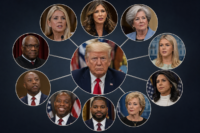
 Racism and sexism have bedeviled this society since its founding. As twin ideologies, they often seem permanent, even immovable. Yet today, another force has emerged that can override both: complicity.
Complicity is not an ideology. It is a tactic. It allows leaders with a record of racial grievance and misogyny to elevate women, Black people, and other minorities into positions of power — not to advance equality, but to protect and execute an agenda that often works against it.
The modern pattern is perhaps most visible in the appointment of Clarence Thomas to the Supreme Court. Thomas replaced Thurgood Marshall, the Court’s first Black justice and a towering figure in the struggle for civil rights. Yet Thomas has become one of the Court’s most conservative members, frequently cloaking positions that undermine civil rights in the language of constitutional fidelity. His reliability in advancing a conservative agenda helped establish a model: representation without resistance.
Others have followed in this mold. Tim Scott was elected in deeply conservative South Carolina with strong backing from white conservative voters. Ben Carson served as Secretary of Housing and Urban Development in the first Trump administration and supported policies that dismantled Obama-era fair housing protections aimed at reducing segregation and discrimination. Byron Donalds a Black conservative Trump ally has emerged as a leading contender in the Republican primary for governor of Florida. These figures are not identical, but they illustrate a broader pattern. Their success raises a deeper question: is this dynamic driven solely by political leaders, or do conservative voters themselves embrace it? The answer appears to be both. Complicity is not only appointed from above; it is also affirmed at the ballot box.
The Trump administration brings this phenomenon into full view. Women have occupied high-profile roles — attorney general, secretaries of education, labor, and homeland security, and director of national intelligence — alongside Black officials and other minorities in prominent positions. On its face, this appears to reflect diversity. But the question is not simply who is appointed, but to what end.
The elevation of Kash Patel, an American of East Indian descent, to lead the FBI is a case in point. Although Patel is a person of color with an immigrant background, he is expected to carry out an agenda that critics argue targets minorities and immigrants — and to shield the administration and President Donald Trump from accountability. Pam Bondi, the resigned attorney general, served a similar function, reinforcing the primacy of loyalty over independence. Opportunism and pliability appear to be requirements for the job, and should not be overlooked as drivers of this tactic. White men in the Trump orbit also fit this description.
Importantly, complicity carries a deeper cost. It compromises integrity and, in doing so, risks severing individuals from the very histories and identities that give their presence meaning. When representation is detached from principle, it can invert its purpose — turning what should be a marker of progress into an instrument of regression.
Trump’s racism and sexism is well documented, as well as his administration’s opposition to DEI. The elevation of women and minorities within his orbit does not signal a departure from those patterns. Rather, it reflects a strategic calculation: complicity can be more valuable than identity. A woman can help dismantle protections for women. A Black official can lend credibility to policies that weaken civil rights protections. Identity, in this context, becomes a form of political cover.
Calling this behavior out is the point. These appointments should not be mistaken for genuine inclusion; too often they produce loyalists willing to carry out the agenda of the leader who elevated them. Representation becomes hollow when it is severed from independence and accountability. Although three women have resigned, the larger point remains: their purpose had already been served.
The irony is that Pete Hegseth at the Pentagon appears to have little patience even for symbolic inclusion, reverting instead to more explicit forms of exclusion rooted in old patterns of racism and sexism. But the broader lesson holds. In this political moment, racism and sexism are not abandoned — they are managed. And when useful, they are subordinated to something more expedient: obedience.
Complicity, in the end, trumps racism and sexism because it serves power.
If this essay mattered to you, future work from On Race in America is delivered directly by email.