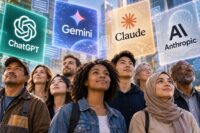
 The recent debate over whether increasingly powerful artificial intelligence could eventually threaten human existence is a fascinating one and deserves serious attention. Recent warnings from researchers developing advanced AI have brought that possibility from science fiction into serious public discussion. I will leave that question largely to scientists, philosophers, and futurists. Lurking much closer, however, is another question: If human beings succeed in harnessing the tremendous power of artificial intelligence, what will that mean for a diverse society and for the democratic principle of equality of opportunity?
The question goes beyond whether artificial intelligence will reflect racial, cultural, or gender bias, important as those concerns are. AI may eventually alter the significance of some differences among human beings themselves. If machines can translate languages instantaneously, provide sophisticated instruction, perform complex analysis, and make specialized knowledge widely available, differences in language, educational preparation, cultural background, and even individual intellectual ability could become less consequential in determining what people are capable of accomplishing.
Here lies the great irony. A technology capable of diminishing some inequalities among human beings could simultaneously create a new and perhaps more consequential inequality: unequal access to artificial intelligence itself.
The important question may increasingly become not simply how intelligent you are or how much education you received, but what intelligence can you access? The difference between an exceptionally intelligent person and someone of ordinary ability matters less if both can draw upon an intelligence vastly more capable than either. But if powerful AI is controlled by a relatively small number of individuals, corporations, universities, or governments, inequality has not disappeared. It has changed form.
If advanced AI becomes essential to education, employment, medicine, scientific discovery, business, legal services, and civic participation, meaningful access to it may eventually have to be regarded less as a luxury product and more as essential social infrastructure. We made comparable judgments about public education, electricity, telephone service, and eventually the Internet. Society recognized that broad access to certain capabilities had become necessary for meaningful participation in modern life.
The question therefore becomes one of distribution as well as regulation. Who owns the most powerful systems? Who controls the computing infrastructure and data on which they depend? Who determines their rules? Who can afford their capabilities? And what obligation does a democratic society have to ensure that this new source of intellectual power is broadly shared?
These concerns are already moving beyond speculation. Former President Barack Obama has called for public regulation of artificial intelligence, arguing that government has a role in steering its development so that its benefits flow broadly rather than principally to a few wealthy corporations. Pope Leo XIV, approaching the issue from a different moral tradition, has similarly warned that concentrated control over digital platforms, infrastructure, data, and computing power risks creating new forms of dependency, exclusion, and inequality. He has called for fair access to opportunity and for AI to remain directed toward the common good. One argument begins with democratic equality; the other with human dignity and social justice. Both raise the same fundamental question: Can a technology capable of reorganizing human opportunity be treated simply as another commodity whose benefits are distributed according to wealth and market power?
This may ultimately be the choice artificial intelligence places before a diverse democracy.
The promise is extraordinary. AI could reduce barriers created by language, geography, educational background, disability, and unequal access to specialized knowledge. It could place capabilities once reserved for wealthy individuals and powerful institutions into the hands of ordinary people.
The peril is equally profound. If its most powerful capabilities become concentrated among a relatively small number of corporations, governments, institutions, and wealthy individuals, AI could create disparities in effective human power unlike anything we have previously experienced.
The future of diversity in the age of artificial intelligence may therefore depend less upon the differences among us than upon what we decide to do with the intelligence we create.
Artificial intelligence may make differences among human beings less consequential. Whether it makes human beings more equal is a choice that remains ours.