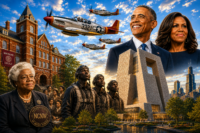
 A defining feature of African American struggles for freedom and democracy has been the institutionalization of excellence. While individual achievement is often celebrated, less attention has been paid to the institutions that deliberately cultivated excellence and transformed it into leadership, service, and social progress. These institutions did more than produce successful individuals; they created cultures that sustained achievement across generations.
Three examples stand out.
During the era of Jim Crow segregation, Morehouse College, under the leadership of Benjamin E. Mays, established a culture of intellectual and moral excellence that shaped generations of leaders. Morehouse produced an extraordinary number of college presidents, physicians, scientists, theologians, and public servants. Its most famous graduate, Martin Luther King Jr., embodied the institution’s commitment to disciplined leadership in the pursuit of justice and democracy.
A similar commitment to excellence emerged at Tuskegee during World War II. Under the leadership of Benjamin O. Davis Jr., the military recruited many of the nation’s most talented African Americans in science, mathematics, and aviation to form the first all-Black fighter squadrons. Through rigorous training and uncompromising standards, the Tuskegee Airmen earned a reputation for skill, courage, and professionalism that became legendary across the European theater. Their achievements demonstrated that excellence could overcome even the most deeply entrenched racial barriers.
Founded in 1935 by Mary McLeod Bethune, the National Council of Negro Women (NCNW) represents another enduring example of institutional excellence. What began as a coalition of Black women’s organizations grew into a national grassroots network dedicated to education, civic engagement, economic advancement, and public service. The NCNW played an important role in the Civil Rights Movement and continues to unite millions of women of African descent through dozens of affiliated organizations and hundreds of community sections. Like Morehouse and Tuskegee, the NCNW demonstrated how disciplined organization and a commitment to service could strengthen both Black communities and American democracy.
The tradition did not end there. The presidency of Barack Obama and the accomplishments of First Lady Michelle Obama represent a modern expression of the same ethos. Their rise to national leadership reflected preparation, discipline, competence, and public service at the highest levels. The recently inaugurated Obama Presidential Center stands as a physical manifestation of that legacy—a monument not merely to political success but to the power of education, leadership, community engagement, and civic responsibility.
There are many other African American institutions that have embodied these values, but Morehouse College, the Tuskegee Airmen, and the National Council of Negro Women are exemplary. Together with the Obama legacy, they demonstrate that genuine greatness is built through excellence.
This lesson is especially relevant today. The MAGA movement frequently invokes the language of “greatness,” yet a contradiction lies at the heart of its vision. Greatness cannot exist without excellence. While the movement often speaks of merit, competence and qualifications, they are too often subordinated to ideological loyalty and personal allegiance. Excellence requires rigorous standards, disciplined preparation, and accountability. Greatness without those qualities is merely a slogan.
The contrast is clear. Morehouse College, the Tuskegee Airmen, the National Council of Negro Women, and the Obama legacy pursued greatness through excellence. Their achievements were earned through preparation, discipline, service, and performance. They remind us that the path forward for America is not found in longing for an imagined past, but in building institutions that cultivate talent, expand opportunity, and strengthen democracy.