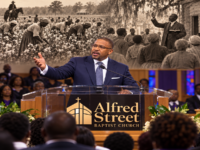
 Listening recently to Dr. Howard-John Wesley, Senior Pastor of Alfred Street Baptist Church, I was struck again by the way his sermons, while frequently alluding to contemporary events, remain firmly grounded in Scripture. His sermon on Sunday, September 20, “In the Beginning,” draws from the first chapter of Genesis.
In the biblical account, as Pastor Wesley explained, God created the heavens and the earth and ultimately created human beings, giving them dominion over the earth. But Genesis makes an even more consequential declaration: human beings were created in the image of God. As Pastor Wesley emphasized, that means we should be able to see something of God in every fellow human being.
Now imagine what that message meant when an enslaved person heard it in a sermon.
The Christian Bible contains ideas fundamentally at odds with the racial hierarchy constructed to justify American slavery. If human beings bear the image of God, the assertion that one race was created inherently superior to another becomes difficult to reconcile with Scripture. An enslaved person hearing this message could discover something quite different from the religion presented by the slaveholder.
Then there was Exodus.
The story of Moses and Pharaoh is the story of an enslaved people seeking freedom from an oppressive power. God hears their cries, confronts Pharaoh, and leads them out of bondage. For people living in slavery, the implications could hardly have been missed. Exodus presented a God concerned with the oppressed and a faith in which liberation was not merely a political aspiration but a sacred cause.
The New Testament carried an equally unsettling message for a society built upon racial hierarchy. Jesus taught love of neighbor, compassion for the poor, care for the stranger, mercy toward the suffering, and recognition of the humanity of people pushed to the margins of society. The parable of the Good Samaritan challenged comfortable boundaries defining whose suffering deserved our concern.
This was one of the great contradictions of American slavery. Christianity was not prohibited among enslaved people. Indeed, slaveholders often encouraged a carefully controlled Christianity emphasizing obedience and submission. But African Americans heard other messages in the same Bible, and African American preachers became among their most important interpreters.
Some of these preachers were enslaved, some free, some formally educated, and many largely self-taught. They interpreted Scripture through the experience of bondage. Moses, Exodus, deliverance, justice, and redemption acquired meanings that could not be separated from the circumstances in which African Americans lived. The Bible that could be used from one pulpit to encourage submission could be interpreted from another as a promise of liberation.
That tradition did not end with emancipation. The African American church became one of the few institutions over which Black Americans exercised substantial control during segregation. Its pulpit could speak to personal salvation while also addressing the collective circumstances of African American life.
W. E. B. Du Bois understood the historical importance of this role. In The Souls of Black Folk, he called the Black preacher “the most unique personality developed by the Negro on American soil,” describing him as a combination of “priest, physician, and judge.” The preacher was not simply a religious figure. He stood at the center of African American communal life, interpreting faith through the circumstances of an oppressed people and helping transform the church into an institution of survival, resistance, and collective advancement.
That tradition reached one of its most powerful expressions in the ministry of Martin Luther King Jr. He did not simply borrow religious language for a political movement. His argument for civil rights was deeply rooted in the prophetic tradition of the Hebrew Bible and the teachings of Jesus. The demand for racial justice became inseparable from the moral principles proclaimed from the pulpit.
It would be a mistake, however, to paint African American preaching with a broad brush. The Black church has never spoken with one voice, and African American ministers today represent a wide range of theological and political perspectives.
But there remain preachers, Howard-John Wesley among them, who continue an old and consequential tradition: interpreting Scripture not merely as a guide to personal salvation but through the circumstances confronting their congregations and communities.
That tradition began long before the modern civil rights movement. Enslaved African Americans encountered a remarkable contradiction. The book used by some to justify their bondage also contained the intellectual and spiritual resources with which to challenge it. Individuals could encounter the text for themselves, but generations of African American preachers interpreted its teachings through the experience of their people.
In their sermons, the Bible became a continuous source of revelation for individual and collective liberation. Today, as African Americans again confront challenges to hard-won rights and opportunities, a return to some of that “old-time religion” practiced by our ancestors could strengthen both individual resolve and collective action, while renewing faith in a God of justice, human dignity, and liberation.