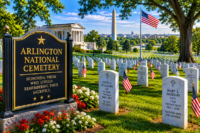
 Why should anyone care about cemeteries long forgotten, overgrown, or buried beneath roads, parking lots, schools, and housing developments? The answer reaches beyond race, geography, or even religion. Since the dawn of civilization, societies have measured their humanity by how they treat their dead. Burial grounds are more than plots of land; they are sacred spaces of memory, dignity, and belonging.
The ancient Egyptians built monumental resting places for their rulers and developed elaborate burial practices reflecting the importance they placed on death and remembrance. Across cultures and centuries, communities have consecrated land to honor the deceased and connect future generations to their past. In America, places such as Arlington National Cemetery and the National September 11 Memorial & Museum embody this same principle. They affirm that the dead deserve reverence, remembrance, and protection.
Yet African American burial grounds in America have too often been denied that same respect.
The history of African American cemeteries reveals one of the nation’s quieter injustices. African Americans were segregated in life and, in many places, segregated in death. Separate cemeteries were established because African American citizens were barred from white burial grounds. But the injustice did not end there. Once isolated and politically vulnerable, many African American cemeteries became targets for neglect, land speculation, and redevelopment. Headstones disappeared. Burial records vanished. Graves were paved over for highways, schools, factories, golf courses, and housing developments. In many cases, the dead themselves were erased from public memory.
It reflected a broader belief that African American history, grief, and humanity were expendable when weighed against economic development and political indifference.
A few years ago, I was contacted by a reporter from the Tampa Bay Times concerning a child in my own family — the infant son of my great-uncle and his wife — who had been buried in Zion Cemetery. That cemetery, once one of Tampa’s most important African American burial grounds, had been destroyed decades earlier to make way for public housing designated for white residents. Countless African American men, women, and children effectively disappeared beneath the foundations of redevelopment.
The discovery transformed the cemetery from an abstract historical injustice into something deeply personal. Today, I participate in efforts, as a member of the Zion Cemetery and Maintenance Society Board, to recover and memorialize Zion Cemetery so that those buried there are no longer forgotten beneath concrete and silence. As of this writing, the City of Tampa has committed to assisting in restoration efforts and memorializing the sacred grounds of Zion Cemetery.
On May 21, 2026, I attended the Black Cemetery Network Conference, held at the University of South Florida St. Petersburg, where descendants, historians, archaeologists, clergy, and community activists from across the country gathered around a common purpose: to recover endangered African American cemeteries and restore them to the American historical landscape.
What is emerging is more than a preservation movement. It is a moral reckoning.
Recovering African American cemeteries is not simply about archaeology or genealogy. It is about restoring dignity to people whose humanity was denied both in life and after death. It is about recognizing that African American history does not begin and end with slavery, segregation, or the Civil Rights Movement. It also lives within families, churches, neighborhoods, and burial grounds that deserve the same protection afforded to battlefields, presidential memorials, and national monuments.
The effort to preserve African American cemeteries also forces America to confront difficult questions: Whose history is preserved? Whose suffering is remembered? And whose remains can be displaced without consequence?
The answers to those questions will help determine whether this nation is prepared to honor its democratic ideals fully. A society that refuses to respect its dead ultimately diminishes the living as well.
The movement to recover African American cemeteries is therefore not merely about reclaiming the past. It is about restoring memory, repairing injustice, and deciding what kind of nation America aspires to be. How we honor the forgotten dead will say much about how fully we value the living.