 The untimely death of college freshman Nolan Wells, whose body was found on an island in Mississippi, has once again drawn national attention to a state whose history remains deeply associated with racial violence. The circumstances surrounding his death remain under investigation, and no conclusions should be drawn until the facts are known. Yet the discovery of a young African American man dead under suspicious circumstances in Mississippi has inevitably revived painful historical memories. Regardless of the investigation’s ultimate findings, the case reminds us that the ghost of Mississippi has never entirely disappeared. It continues to haunt the nation’s conscience. As Nina Simone sang more than sixty years ago, “Mississippi Goddam.”
During the Jim Crow era, the South was, in many respects, a dangerous place for African Americans. But for those of us who lived through that period, Mississippi occupied a singular place in our fears. It was widely regarded as the epicenter of racial terror.
Between 1877 and 1950, more than 4,000 African American men, women, and children were lynched in the United States, according to the Equal Justice Initiative. Mississippi alone accounted for 581 documented lynchings—the highest number of any state. These killings were not random acts of violence. They were instruments of terror, designed to enforce white supremacy through intimidation and fear.
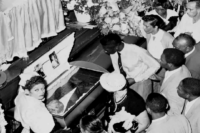
Mississippi’s history is marked by some of the nation’s most infamous racial murders. In 1955, fourteen-year-old Emmett Till was kidnapped, tortured, and murdered, helping to awaken the nation’s conscience. In 1963, Medgar Evers, the NAACP’s Mississippi field secretary and one of the state’s most courageous civil rights leaders, was assassinated in the driveway of his Jackson home. His murder underscored the deadly consequences of challenging white supremacy in Mississippi. The following year, civil rights workers James Chaney, Andrew Goodman, and Michael Schwerner were abducted and murdered during Freedom Summer while helping register African American voters. Together, these crimes became enduring symbols of the violent resistance to racial equality
The history did not end with the civil rights movement. As Washington Post journalist DeNeen L. Brown reported, attorney Jill Collen Jefferson has spent years documenting suspicious deaths of African Americans in Mississippi that families believe were never adequately investigated. Jefferson reached a disturbing conclusion: while the methods may have changed and the legal system no longer sanctioned racial terror, suspicious deaths continued to occur. As she put it, “Lynchings in Mississippi never stopped.”
Lynching, however, was only one expression of Mississippi’s racial order. The state operated one of the nation’s most notorious convict leasing systems, replacing slavery with forced prison labor that disproportionately ensnared African Americans. Mississippi’s infamous Parchman Farm became a symbol of brutality and exploitation. Even today, Mississippi remains the only state that officially observes Confederate Memorial Day as a state holiday and continues to recognize April as Confederate Heritage Month—public commemorations that many view as honoring a Confederacy founded to preserve slavery.
Although Mississippi has made important progress since the civil rights era, the legacy of this history continues to shape the state. African Americans comprise nearly two-fifths of the population, yet continue to experience disproportionately high poverty rates, persistent residential and educational segregation, and unequal economic opportunity. Many public schools remain effectively segregated, while private “segregation academies,” established during the resistance to school integration, continue to educate thousands of students. Mississippi is not alone in confronting these challenges, but it continues to rank among the states where the legacy of racial inequality remains most visible.
America rightly celebrates itself as a nation founded upon liberty, equality, and the rule of law. Mississippi’s history reminds us how difficult those ideals have often been to achieve.
The tragedy surrounding Nolan Wells has reminded Americans that history is never entirely past. Whatever the investigation ultimately concludes, the public reaction reveals an uncomfortable truth: Mississippi’s history of racial terror remains so deeply embedded in the nation’s memory that unexplained deaths still awaken old fears. The ghost of Mississippi is not simply the memory of past violence. It is the enduring legacy of a history that Americans have never fully confronted—and therefore have never fully escaped.