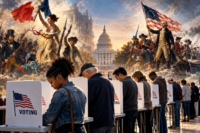
 One of the truisms of life is that history is always instructive.
The French Revolution (1789–1799) and the American Revolution (1775–1783) differed greatly in their circumstances and outcomes, but they shared a fundamental idea: political power ultimately belongs to the people, not to a monarch or ruling class.
The American colonists rebelled against King George III and the British system of government, which they believed had violated rights and liberties they had long enjoyed. The French revolutionaries rebelled against the monarchy of Louis XVI, entrenched social inequality, political privilege, and severe economic hardship. The aspirations of the French Revolution would eventually be captured in the national motto: Liberté, égalité, fraternité — liberty, equality, fraternity.
The American Revolution gave rise to foundational political and philosophical principles rooted in the European Enlightenment and the English political tradition. They are expressed most memorably in the Declaration of Independence and were later incorporated, imperfectly but consequentially, into the Constitution and Bill of Rights.
Among them were natural rights, the belief that individuals possess inherent and unalienable rights; popular sovereignty, the principle that legitimate political authority derives from the consent of the governed; and the rule of law, the principle that government itself must be constrained by law. Equally important were representative government, a written constitution, separation of powers, and protections for individual rights and civil liberties.
The French and American revolutions therefore shared a revolutionary proposition: the ultimate political power of a nation belongs to its citizens, and the legitimacy of government depends upon their consent. Both challenged the centuries-old belief that kings possessed a divinely sanctioned right to rule. In both cases, disputes over taxation and economic burdens helped ignite much deeper conflicts over political power and representation.
Yet both revolutions contained profound contradictions.
Both proclaimed principles of human equality while failing to apply them universally. The American Revolution left chattel slavery intact and excluded women and Indigenous peoples from the political community it created. The French Revolution initially denied women equal political rights, struggled with slavery in its colonies, passed through the violence of the Reign of Terror, and eventually gave way to the authoritarian rule of Napoleon Bonaparte.
History seldom travels in a straight line.
Nevertheless, our modern conception of democratic citizenship owes an enormous debt to the American and French revolutions. Together with other democratic movements, they helped transform the political meaning of a nation from a population of subjects ruled by sovereigns into a community of citizens possessing political rights and ultimate political authority.
That history deserves our attention today.
America is again confronting fundamental questions about the limits of presidential power, the independence of democratic institutions, corruption in public office, diminution of representative government, abuse of civil and human rights, and the immoral and unchecked use of American power abroad. We are witnessing, in the Trump administration, an authoritarian impulse that tests constitutional restraints and asks Americans once again to decide how much power they are willing to surrender to those who govern them.
The French expression déjà vu literally means “already seen.” The revolutions of the eighteenth century offer us something more useful than the eerie feeling that we have seen aspects of our present circumstances before. They remind us that liberty and democracy are neither inevitable nor self-sustaining. They survive only when citizens are willing to defend them.
Fortunately, Americans today do not need an armed revolution to defend the principles for which earlier generations struggled. We possess something those revolutionaries had to fight to obtain: the ballot.
In a few weeks, Americans will again exercise that power.
The question is whether we will summon the same human spirit that, however imperfectly, helped transform subjects into citizens more than two centuries ago. Will we defend representative government, the rule of law, individual liberty, and the principle that no president is a king?
History is instructive.
But only if we are willing to learn from it.