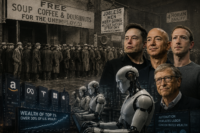
 The specter of extreme wealth inequality has returned to America. Once again, the nation confronts levels of concentrated wealth not seen since the Gilded Age and the years preceding the Great Depression.
The central question is no longer simply why some people are wealthy while others struggle. Rather, it is whether democracy can flourish when a small elite exercises disproportionate influence over the nation’s economic, political, and cultural life.
The United States has traveled this road before. By 1929, the richest one percent of Americans controlled roughly a quarter of the nation’s wealth. While a few amassed enormous fortunes, millions of workers and farmers faced economic insecurity. The result was a society marked by deep disparities in opportunity and economic security.
Today, wealth inequality has again reached extraordinary levels. The wealthiest one percent of Americans now control roughly one-third of all household wealth. America has also long struggled with persistent inequalities among ordinary citizens, including racial wealth gaps rooted in discrimination, segregation, and unequal access to housing, education, employment, and capital. These disparities remain important. Yet the central challenge of our moment extends beyond these long-standing inequalities.
A new concentration of wealth and power has emerged in the hands of a relatively small billionaire and millionaire class. Unlike earlier generations of wealthy Americans, today’s economic elites possess unprecedented influence through technology platforms, media ownership, financial markets, and political spending. Their wealth gives them the ability not only to shape markets but also to shape public debate itself.
Periods of extreme inequality often produce efforts to justify existing arrangements. The elites of our age would prefer that public attention focus on the alleged deficiencies of others rather than on how extraordinary fortunes were accumulated or how concentrated wealth translates into political and cultural power. Increasingly, inequality is portrayed not as the product of institutions, policies, and historical circumstances, but as the natural consequence of differences in human ability.
In recent years, Elon Musk, the world’s richest person, and other influential voices have revived discussions about intelligence, merit, and social hierarchy that echo older efforts to explain economic outcomes through innate characteristics rather than historical and social conditions. Whether presented as science, meritocracy, or elite efficiency, these arguments risk transforming inequality into a judgment about human worth. (See this link for further discussion of this subject)
The danger is compounded when economic concentration is paired with populist politics. Elements of the billionaire class have aligned themselves with a populist movement contained within the Republican Party that channels public frustration toward immigrants, racial minorities, universities, cultural institutions, and government itself. The result is a politics that often obscures the growing concentration of wealth and power while simultaneously helping to justify and preserve it.
America has confronted concentrations of wealth and power before. The response to the excesses of the first Gilded Age was not to search for biological explanations for wealth and poverty. Instead, reformers pursued policies that broadened opportunity and limited concentrations of economic power. Progressive Era reforms and the New Deal strengthened labor rights, regulated financial markets, expanded public education, established Social Security, and created a more progressive tax system. While imperfect, these policies helped build a broad middle class and reduced inequality. (See this link for further discussion of this subject)
The challenge today is not to punish success or discourage innovation. It is to ensure that no individual, corporation, or economic class acquires so much power that it can dominate the nation’s political, economic, and cultural life. Democracies require accountability, transparency, and broadly shared opportunity. They cannot function indefinitely when wealth becomes power and power becomes self-perpetuating.
The central question facing America is whether democratic institutions can once again rise to meet this challenge. If citizens allow themselves to be divided by cultural grievances and scapegoats while wealth and influence become increasingly concentrated, the answer may be no. But if Americans recognize the threat and demand reforms that restore democratic accountability, they can do what previous generations did: preserve both economic opportunity and democratic self-government.
The future of American democracy may depend upon it.